
Augmented Reality in Medical Training: A B2B Perspective in Europe
Sarah Richards, Editorial Team, European Hospital & Healthcare Management
The technique commonly known as augmented reality which has been assigned the acronym AR has significantly and positively impacted the way especially medical training is conducted to the learners. This article analyses the use of AR in medical training from a B2B standpoint with special emphasis on Europe. It also reviews the potential advantages for healthcare givers, AR developers and technology companies, identifies areas of suitability and discusses issues and future possibilities. About AR in context of a healthcare education Europe has highly developed medical and technology industries to foster a transformed future.
Introduction: The Rise of AR in Medical Training
Augmented Reality (AR) is compliments and extends the analog environment by adding information on the perception of objects in the user’s real life. In medical learning, this technology is outstanding as it offers real experience, which can be relied on in real practice without compromising the life of patients. Having been an early adopter of technology and medical research, Europe is experiencing increased use of AR. AR becomes a powerful tool for businesses that promote solutions for medical facilities, educational establishments and hospitals, as it allows to set up unique and specific contextual solutions.
Benefits of AR in Medical Training
1. Enhanced Learning Outcomes
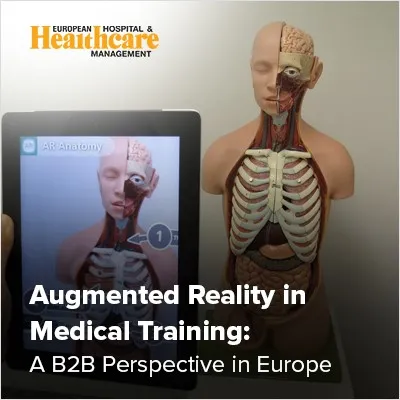
Through the use of AR, medical trainees are able to view the aspects or results of a practicing situation in three dimensions. For example, a didactic demonstration where students can learn anatomy where they can rotate a human body and view the inner organs and the systems. This, in turn, helps in explaining complex structures and can do so without have to go through bulky text books or even cadavers.
2. Safe Practice Environments
In this area, using AR, the medical personnel can rehearse operations and the like in safety. The mistake made in these simulations does not harm patients, which makes it appropriate to practice with this method and build confidence.
3. Cost Efficiency
AR training minimizes the use of cadavers, medical equipment, or small surgical theaters during the actual training practice. In the long run, this results to massive savings for the medical institutions and the training facilities.
4. Customization and Scalability
AR applications may depend on the specialization of a medical field ranging from cardiovascular to orthopedic. Also, they are flexible, along with the fact they can be used for one learner, a group of learners or even an organization.
Key Applications of AR in Medical Training
1. Surgical Training
Specialize AR applications like Hololens can present overlays during surgeries to trainers in real-time. Laparoscopic surgeries or neurosurgeries can be mimicked in AR tools which reflect real life conditions that surgeons can face.
2. Patient Interaction Simulations
AR helps fill the gaps in skills concerning patient engagement, for example, diagnosing mental disorders or managing crises. Virtual patients allow trainees to practice speaking to the patient and become good at diagnosing the problem.
3. Emergency Response Training
Firefighters and staff working in the emergency services can practice different emergencies such as a sudden influx of the number of victims or cardiac arrest through means of AR. This makes them well fit to handle stress since they are prepared physically for the position.
4. Anatomy and Physiology Education
A conventional anatomy lab entails costly and exhaustive instrumentation. AR can serve as a companion in this area with the virtue of allowing students to proceed through human anatomy playfully, focusing on an organ level, or selecting a disease that may be studied as a virtual exploration of its effects on the human body.
Europe’s Advantage in AR Adoption
1. Advanced Medical Infrastructure
Modern European countries have inherited traditions of the great academic and clinic centers of world’s medical science. Germany, France, the UK and so forth have not failed to incorporate AR in various medical training programs.
2. Thriving Technology Ecosystem
Current research shows that European enterprise software companies- ranging from the small players to giants such as Siemens are investing greatly in AR solutions. Healthcare and technology industry networking help advance AR and integrate healthcare and technology industries.
3. Supportive Policies and Funding
Funding for the digital innovation is supported by the European Union particularly in the field of AR in health care systems. Incentivizing the development of such revolutionary ideas, initiatives such as Horizon Europe prompt organizations to create bespoke augmented reality applications for the healthcare industry.
B2B Opportunities in AR Medical Training
1. AR Solution Providers
Businesses focused on creating AR systems are rapidly finding their niche among European medical organizations. These providers can develop specific platforms for strained operations, lessons on bones and muscles, or interactions with patients.
2. Training and Certification Partners
B 2 B relations can also last into delivering Augmented Reality based certification programs for medical practitioners. Businesses that work with partnering universities and hospitals can guarantee that their augmented reality solutions are relevant within the given industry.
3. Hardware and Software Providers
Other aspects include head-mounted displays, such as AR glasses, as well as application software. As a result, the European tech companies have an opportunity to benefit from offering the modern and high-quality hardware enriched with the convenient software and vice versa.
4. Data Integration and Analytics
AR platforms provide useful information regarding performance of the trainee. Analytics solution proposing B2B companies can assist medical institutions in evaluating learning outcomes and enhancing learning approaches.
Challenges in Implementing AR in Medical Training
1. High Initial Costs
Implementing and integration of AR need a lot of capital investment. Many medical institutions may also be hesitant because of funding and this is even more so with small hospitals or training facilities.
2. Integration with Existing Systems
For AR platforms to be successful, they must complement current approaches to training and existing training solutions. This may be so because organizations may not find the existing information systems compatible with the adopted technology.
3. Need for Technical Expertise
Teaching medical staff to use the AR technology takes time and even though it may take time, it is worth the effort. There is a need for business organizations to offer effective onboarding so that its implementation can run smoothly.
4. Ethical and Privacy Concerns
Integration of functions that require handling of sensitive medical data in AR environments is a major concern regarding to security and ethics. Analyzing data protection, we can affirm that trust is achieved when organizations pay attention to minimizing the-method risks.
Future Trends and Opportunities
1. AI Integration
When integrated, the application of AR with AI can develop additional complex training that focuses on the aptitude level of the learner. For example, in the training process, AI-based applications of augmented reality can help in achieving feedback during the simulation.
2. Remote Training Solutions
Drugs and telemedicine means that widespread remote AR training is now an issue. It comprises great news for trainees, as they can get professional medical education from certified establishments without moving to other regions.
3. Gamification in Training
The use of games in the AR solutions will make it easier to improve engagement levels as well as the retention of information. Simulations can be made more engaging by the ability of trainees to gain point and other incentives for the success of a simulation.
4. Cross-industry Collaborations
AR training may find mutual benefit in developing complete training solutions in collaboration between the AR companies, medical institutions, and pharmaceutical firms. For instance, pharma can employ AR in teaching other healthcare professionals on new mechanisms in drug kinds.
Conclusion: Shaping the Future of Medical Training in Europe
Augmented Reality is changing the way that doctors are being educated, provided unlimited opportunities which would allow immersive practice. This transformation is well suited to take place in Europe as it has the advanced healthcare infrastructure bundled with tech innovation. AR in medical training is an extremely promising area for B2B companies because of the incredible potential for expansion and partnership. Whereas cost and integration issues remain critical barriers to the widespread adoption of AR, once these have been addressed it allows, for the future, to regard them as a regular tool in the teaching of medicine.
Embracing AR keeps European medical education impressive while also providing improved patient care, making Europe a world pioneer in innovation.

Sarah Richards, a member of the Editorial Team at European Hospital & Healthcare Management, uses her extensive background in healthcare communication to create clear and engaging content. With a strong commitment to making complex healthcare topics accessible, Sarah helps the team achieve its goal of delivering timely and impactful information to the global healthcare community.