
Beyond the Operational Plan: Why Hospitals Need a Strategic Layer for Crisis Steering
Dr. Jan-Cédric Hansen, Chief Medical Officer at the Centre for Geriatric Care and Support (CHAG), Pacy-sur-Eure
European healthcare systems have established structured operational frameworks for crisis preparedness, yet a critical gap remains in strategic decision-making during unfolding events. This article highlights the need for “strategic steering” alongside procedural planning, emphasizing decision frameworks, leadership dynamics, and adaptive thinking to help hospital crisis cells respond effectively to complex, evolving emergencies.
Hospitals and healthcare institutions across Europe are increasingly required to prepare for exceptional health situations: pandemics, cyberattacks, structural failures, and organisational or communication breakdowns. In France, the Methodological Guide for Developing the Hospital Strain Management and Exceptional Health Situations Plan (commonly referred to as the PGTHSSE guide), published by the Ministry of Health in 2024, provides a rigorous and structured framework for preparing hospital responses to these events.
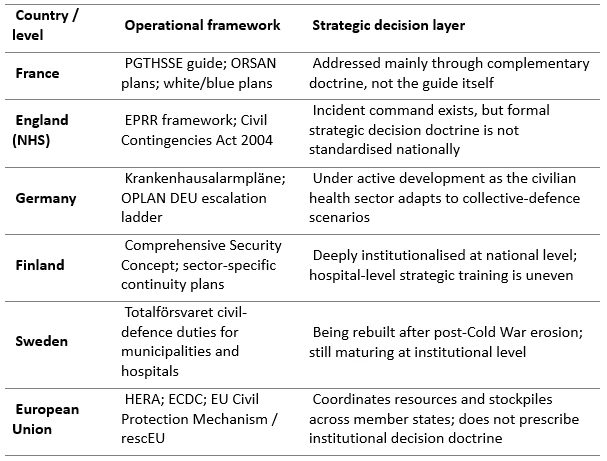
Every major European health system has built an equivalent architecture. In England, NHS-funded organisations operate under the Emergency Preparedness, Resilience and Response (EPRR) framework, grounded in the Civil Contingencies Act 2004, which sets core standards for major incident, critical incident and business continuity response. In Germany, hospital-level Krankenhausalarmpläne (hospital alert plans) sit within a wider civil protection architecture now being reshaped by the Operationsplan Deutschland, the Bundeswehr's framework for national and collective defence support. In Finland, hospitals operate under the Comprehensive Security Concept, a whole-of-society doctrine in which healthcare, alongside energy and logistics, has a defined wartime role built in from peacetime, coordinated by the Security Committee attached to the Ministry of Defence. Sweden is rebuilding a comparable Totalförsvaret (total defence) tradition, under which municipalities, utilities and hospitals hold explicit statutory preparedness duties. At EU level, the Health Emergency Preparedness and Response Authority (HERA), established in 2021 within the European Commission, coordinates medical countermeasure stockpiling and procurement across member states, working alongside the European Centre for Disease Prevention and Control (ECDC) and the EU Civil Protection Mechanism.
All of these frameworks answer a fundamental question: how should the response be organised? They describe escalation plans, regional or national coordination mechanisms, and the tools needed to align actors such as health authorities, hospital directors, clinicians and logistics teams. What none of them fully answers, at least not explicitly, is a second and equally important question: how should decisions be made while the crisis is still unfolding?
Why "steering", not "management"
A crisis is not an object that can be managed. It is a dynamic process, driven by internal and external forces well beyond the control of any single institution, that keeps evolving whether or not the response plan keeps pace with it. What a hospital's leadership can genuinely act on are the decisions, resources, teams and operational consequences arising from that crisis. Their task, therefore, is less to "manage" the crisis itself than to steer the institution's response system through it, correcting course as new information, new constraints and new consequences appear. That distinction between managing an event and steering a system through it is more than semantic: it shapes what a crisis cell trains for, and what it is willing to admit it does not yet know at any given moment.
The strategic gap in operational planning
Operational guides are, by design, concerned with planning: they specify roles, escalation triggers and coordination channels. Strategic judgement, however, tends to be addressed only implicitly, mostly through an institution's positioning within broader regional or national response networks rather than through a dedicated methodology for structured decision-making. Research on hospital leadership during sustained crises confirms the risk this creates: chief executives under pressure tend to drift toward short-term, narrowly operational decisions, with less lateral communication across departments and less room reserved for longer-term considerations, unless a distinct strategic function is deliberately protected from being pulled into day-to-day firefighting (Romiti et al., 2025).
This gap is consistent across systems. The NHS EPRR framework sets clear compliance standards for on-call arrangements, communications cascades and business continuity plans, but says comparatively little about how an incident director should reason once the situation departs from the scenarios the plan anticipated. Germany's OPLAN DEU brings together, for the first time, the military and civilian dimensions of national defence support along an escalation ladder running from peacetime through hybrid threat, crisis and war — yet the civilian health sector's own strategic decision doctrine within that ladder remains, by most accounts, still under construction, a gap German clinicians documented directly during the Covid-19 pandemic (Weiss & Hofinger, 2022). Nordic total-defence doctrine, despite decades of institutional depth, faces a related challenge: Finland and Sweden are recognised for their whole-of-society mobilisation culture, but even there, hospital boards report feeling reasonably prepared for acute, short-lived incidents while expressing far less confidence in their capacity to sustain strategic decision-making through a prolonged, multi-week crisis (Schlinkert et al., 2024).
A complementary approach: strategic steering
A strategic layer of crisis response complements operational planning by adding several elements that pure procedure cannot supply:
- Situational analysis grounded in cindynics (the science of danger), used to map vulnerabilities and anticipate complex scenarios rather than simply reacting to the triggering event.
- A structured decision framework, organised around three phases — confront, regulate, and overcome, a cindynics-based metamodel set out in the French strategic crisis literature (Hansen, 2024) — which tracks how a crisis evolves in response to the decisions and trade-offs made by the crisis cell, echoing the dynamic-capabilities model of anticipating, absorbing and recovering from disruption that underpins much of the international resilience literature (Rosenbäck & Eriksson, 2024).
- Attention to the human dimension of decision-making, including the psychological states of decision-makers under pressure, and to the relational and professional friction that can develop between clinical and administrative leadership when the split between them is not clearly bounded — a split formalised differently from one European system to the next, whether as a director-general/medical-crisis-director pairing in France, an LNA/OrgL tandem in the German-speaking countries, or a medical officer nested inside a tiered Gold/Silver/Bronze-style command elsewhere (Verhoeven et al., 2024).
- Iterative decision cycles, designed to counter "tunnel effect" thinking, in which urgent short-term tasks crowd out situational awareness and longer-term consequences.
A practical illustration
The three-phase decision framework can be summarised as follows:
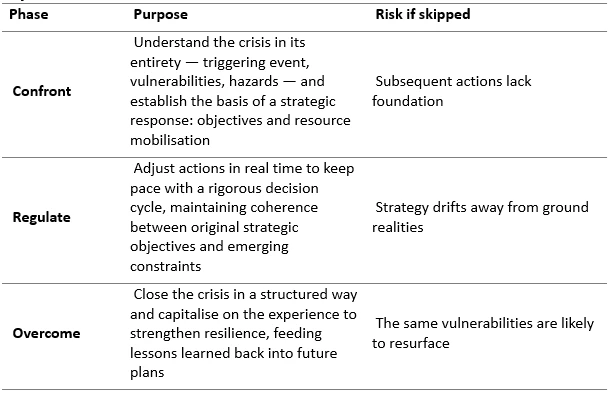
This is not a substitute for operational planning; it is the reasoning layer that sits above it, guiding how operational tools — whether a French PGTHSSE plan, an NHS EPRR incident response plan, a German Krankenhausalarmplan, or a Finnish comprehensive-security sector plan — are actually used once the situation stops following the script.
National frameworks compared
Two questions for hospital leadership
Two sets of tools, used together, are more likely to produce genuine institutional resilience than either used alone: procedures that specify what to do, and a decision framework that clarifies how to think while doing it.
Hospital and healthcare executives preparing their crisis response arrangements, in any of these systems, might usefully ask two questions. First, does the institution's crisis cell know how to distinguish, in real time, between what is strategic and what is merely tactical? Second, is the crisis cell trained to look beyond the immediate triggering event and track the cascading effects it sets in motion — on staffing, on budgets, on partner organisations, and on public trust — over the following hours, days, weeks and months?
Operational readiness answers the question of what to do. Strategic steering answers the question of how to decide, and how to keep deciding well, as the picture keeps changing. Both are needed for a hospital to move from simply reacting to a crisis to genuinely steering its way through one.
References
- Hansen, J.-C. (Ed.). (2024). Piloter et décider en SSE: Situations Sanitaires Exceptionnelles — Stratégie, Méthodologie, Application. LEH Édition.
- Romiti, A., Del Vecchio, M., Cavicchi, C., & Vagnoni, E. (2025). Healthcare organizations in crisis context: decision-making models and roles of CEOs. BMC Health Services Research, 25. https://doi.org/10.1186/s12913-025-12420-6
- Rosenbäck, R., & Eriksson, K. M. (2024). COVID-19 healthcare success or failure? Crisis management explained by dynamic capabilities. BMC Health Services Research, 24. https://doi.org/10.1186/s12913-024-11201-x
- Schlinkert, C., Muns, L., Van Tuyl, L. V., & Wagner, C. (2024). How well prepared are hospitals for future crises? Board members perceive their hospitals as resilient for acute crises. BMC Health Services Research, 24. https://doi.org/10.1186/s12913-024-11197-4
- Verhoeven, A., Van De Loo, E., Marres, H., & Lalleman, P. C. B. (2024). Nurses' Relational Leadership Struggles on Positioning in Strategic Hospital Crisis Management: A Qualitative Interpretive Study. Journal of Nursing Management, 2024. https://doi.org/10.1155/2024/9212508
- Weiss, S., & Hofinger, G. (2022). [Hospital Crisis Management in the Pandemic]. Anästhesiologie, Intensivmedizin, Notfallmedizin, Schmerztherapie: AINS, 57(10), 629-641. https://doi.org/10.1055/a-1710-2210
- This article draws on and develops themes first published by Jan-Cédric Hansen, "Au-delà des plans Blanc, Bleu, PCA, PRE…", LinkedIn, December 2025.

Dr. Jan-Cédric Hansen is Medical Coordinator and Board Administrator at CHAG Hospital, France, and serves on the Medical Board and Strategic Committee of the Eure-Seine-Vallée d'Ouche Hospital Trust. A leading expert in disaster medicine, global health security, and crisis governance, he holds senior leadership roles in several international organizations. Editor of Piloter et décider en SSE (2024), he developed the confront-regulate-overcome metamodel. His clinical and governance experience across France, Canada, and Scandinavia informs his work on European crisis management and resilience.