EHDS Secondary Use of Health Data: Research, Innovation and Access Rules
Kate Williamson, Editorial Team, European Hospital & Healthcare Management
The EHDS secondary use of health data framework lets researchers, innovators and policymakers access pseudonymized or anonymized European health data under strict safeguards. This article explains how Health Data Access Bodies, data permits and HealthData@EU work, who can apply, what is prohibited, and when the rules begin to apply.
Every hospital visit, lab result and prescription creates data. For decades, most of it has sat in separate systems: useful for one patient’s care, invisible to the researcher who might spot a pattern across a million of them.
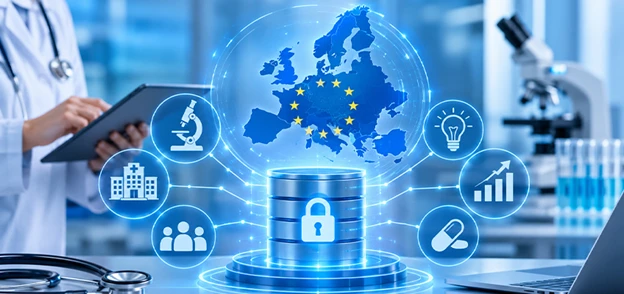
The European Health Data Space (EHDS) is built to change that. Its second big promise, after giving patients better control of their own records, is EHDS secondary use of health data: reusing health data for research, innovation, policy and public health, with privacy protections built in.
If you work in a university, a hospital, a biotech startup or a health ministry, this will affect how you get data. Here is how it works.
What is EHDS secondary use of health data?
EHDS secondary use of health data means reusing electronic health data, originally collected for patient care, for purposes beyond that care, such as research, innovation, policymaking and statistics. It operates under Regulation (EU) 2025/327, which entered into force in March 2025.
The key idea is that data is not simply handed over. Access is controlled, purpose-limited and, in most cases, takes place inside a secure environment where you analyze the data but cannot walk away with the raw records.
Why does secondary use of electronic health data matter?
Think about what Europe loses today. A researcher studying a rare disease may need patient data from five countries. That means five sets of rules, five application processes and often five different data formats. Many projects stall or never start.
The EHDS aims to replace that patchwork with a common framework. Better access to health data for medical research in Europe could mean faster insight into disease patterns, stronger evidence for health policy, and AI tools trained and tested on more representative data.
What can the data be used for?
The Regulation lists permitted purposes. In plain language, you can request data for:
- Public interest in public and occupational health, such as disease surveillance or health threats
- Policy-making and regulatory activities
- Official statistics
- Education and teaching in health and care
- Scientific research
- Development and innovation of products and services, including training and testing AI systems
- Personalized healthcare
The categories of data are broad: electronic health records, genomic data, registries, clinical trial data, data from medical devices and wellness apps, and biobank data, among others.
What is prohibited?
This part matters as much as the permissions. The Regulation bans uses such as:
- Making decisions that harm individuals, for example denying insurance or changing loan terms based on health data
- Advertising and marketing aimed at health professionals or patients
- Offering or selling data to third parties not named in the permit
- Developing products designed to harm people or society
- Trying to re-identify anyone
If a project drifts into one of these areas, the permit can be withdrawn.
Who decides who gets access? Meet the Health Data Access Bodies
Health Data Access Bodies (HDABs) are national authorities that each EU country must designate to review requests, grant permits and supervise how data is used. Think of them as the front desk for EHDS health data access.
Their job is to:
- Receive and assess applications
- Check that the purpose is legitimate and the safeguards are adequate
- Collect the data from data holders and prepare it for use
- Provide a secure processing environment
- Monitor compliance and publish information on permitted projects
For applicants, the practical benefit is a single-entry point. Instead of approaching every hospital or registry separately, you deal with the HDAB, which coordinates with the data holders.
How do EHDS data access permits work?
There are two routes, depending on what you need.
1. A data request is for anonymized, statistical data. It is the lighter option. If aggregated figures answer your question, this route is faster and involves fewer safeguards.
2. A data permit is for pseudonymized data, where records are stripped of direct identifiers but remain linkable at the individual level. This is what most serious research needs. EHDS data access permits are granted for a defined purpose and a limited time, which can run up to ten years and can be extended.
A typical application covers:
- Who you are and your organization
- The specific purpose and why you need this data
- The datasets requested and the period they cover
- Your security measures and why pseudonymized data is necessary
- Expected benefits and, where relevant, ethical review
Under the Regulation, the HDAB generally has three months to decide, and it can extend that by a further three months for complex cases. Data holders then have a set period, again generally three months, to supply the data.
Some requests cross borders. If your project needs data from several countries, you can apply through one HDAB and the others cooperate, rather than you repeating the process in each country.
What is HealthData@EU?
HealthData@EU is the cross-border infrastructure that connects national access bodies so researchers can work with data from more than one country through a single process.
Each country has a national contact point for secondary use. These points link into HealthData@EU, which lets applicants discover datasets and run multi-country projects. A related piece is the EU health data catalogue, where datasets are described so you can see what exists before you apply.
For a researcher, this is the difference between knowing data exists and being able to find and reach it.
Is your data safe? How privacy is protected
Patients and doctors reasonably ask this first. The safeguards are layered:
- Secure processing environments. Data stays in a controlled environment. You analyze it there, and only non-identifying results leave, after checks.
- Pseudonymization and anonymization. Direct identifiers are removed, and the least identifiable form that still serves the purpose is the default.
- Purpose limitation. You can use data only for what the permit says.
- Logging and oversight. Access is recorded and supervised.
- Opt-out rights. Individuals can opt out of the secondary use of their data, with defined exceptions for certain public-interest purposes, depending on national rules.
- Transparency. Data users must publish their results, generally within 18 months of finishing, so the public benefit is visible.
What does this mean for innovators and startups?
Smaller companies have often been shut out of health data because they cannot negotiate with dozens of data holders. A single route through an HDAB lowers that barrier.
Practical points to know:
- AI training and testing are explicitly listed as a purpose, but they still need a clear, lawful justification.
- Fees are allowed to cover costs, and the Regulation expects them to be transparent and proportionate.
- Trade secrets and intellectual property are protected, so data holders can flag sensitive content, and applicants must respect those protections.
When do the rules apply?
The Regulation is already in force, but the secondary use system is being phased in. The broad pattern is that Member States must put their structures in place first, including designating Health Data Access Bodies, with most of the secondary use rules applying from around March 2029 and certain data categories following later, around 2031. Exact dates vary by provision, so check the official text of Regulation (EU) 2025/327 before planning a project.
How to prepare now
You do not have to wait for the deadline to get ready. Useful steps:
- Map your data needs. Know which datasets, countries and time periods you require.
- Write a clear purpose statement. Vague applications will struggle.
- Check whether anonymized data is enough. If it is, you may avoid the heavier permit route.
- Review your security and governance setup. Expect to prove you can protect the data.
- Follow your national HDAB. Guidance, forms and timelines will come from there.
Quick answers
Who can apply for EHDS data access?
Researchers, companies, public bodies and institutions with a legitimate permitted purpose. Prohibited uses disqualify an application.
Is the data identifiable?
Generally, not. Access is to anonymized or pseudonymized data, and re-identification is banned.
Can data leave the secure environment?
Raw data cannot. Only approved, non-identifying results can.
Do I need approval in every EU country?
Not necessarily. Cross-border projects can run through coordinated access via HealthData@EU.
Does this replace GDPR?
No. It works alongside it, adding sector-specific rules.
The bottom line
The EHDS will not make health data free-for-all. It makes access structured, fair and accountable, which is what both researchers and patients need. If you work with data, the smartest move is to understand the process now, before the queue forms.

Kate, Editorial Team at European Hospital & Healthcare Management, leverages her extensive background in Healthcare communication to craft insightful and accessible content. With a passion for translating complex Healthcare concepts, Kate contributes to the team's mission of delivering up-to-date and impactful information to the global Healthcare community.