
Europe's Telehealth Transformation: Reimagining Care Delivery in a Digital Era
Transforming Healthcare through Virtual Care and Innovation
Sagar Mukhekar, Industry Analyst, Frost & Sullivan
Healthcare providers across Europe face growing internal and external pressures to maintain operational, financial, and clinical efficiency. These pressures are driving a shift toward long-term strategies to transform healthcare delivery. Telehealth is emerging as a critical enabler in this transformation, helping reduce inpatient care burdens, improving accessibility, supporting elderly care, and enhancing care quality and outcomes through virtual, patient-centered services.
Introduction:
Telehealth in Europe has witnessed a gradual evolution from the pilots during the 2010s, followed by accelerated uptake of RPM and virtual consultation solutions during the COVID-19 pandemic, which subsequently stabilised after the pandemic. It is now transitioning to become a mainstream, regulated care delivery model powered with the latest technologies, including AI, analytics, and wearables. Solidifying its position as an efficient healthcare delivery route, it aims to provide elderly care and chronic disease management as the biggest opportunities
Healthcare providers are facing a myriad of external and internal challenges in this ever-evolving industry. They face immense pressure to maintain operational, financial, and clinical efficiency. Poor physician-to-patient ratio caused by clinician burnout, healthcare workforce migration to high-income countries, and the subsequent shortage has forced healthcare systems to realise the long-term importance of telehealth beyond pandemic-driven demand. Healthcare providers are now focusing on developing virtual care capabilities to combat the healthcare workforce shortage and cost reduction and cater to dynamic patient demands. It has continued the shift towards long-term strategies to transform healthcare delivery. Telehealth will be an integral component of this transformation as it helps ease the inpatient care load, enables convenient and affordable patient care with reduced hospital visits, especially for elderly care, and improves care quality and outcomes.
Why is Telehealth critical today?
The healthcare industry in the European region is grappling with a range of challenges:
Shortage and uneven distribution of the healthcare workforce are emerging as a critical challenge. The European region is facing a substantial deficit in its healthcare workforce, with over 20 countries reporting shortages of physicians and over 15 countries reporting scarcity of nurses. WHO estimated a deficit of over 4.1 million healthcare professionals, including physicians, nurses, and midwives, in the EU by 2030. Moreover, there is an uneven distribution of healthcare professionals, with some regions facing significant shortages while others have a surplus. Such a burdened healthcare system compels the need for telehealth for efficient care delivery and reduced unnecessary inpatient interventions.
Additionally, there are evident variations within and between the EU member states related to healthcare access, healthcare expenditure, quality, and outcomes. Some countries even have healthcare access disparities between different population groups as well as different population groups. Lack of coordination and fragmented care are other issues impacting accessible and high-quality patient care, even in countries with efficient and adequate healthcare infrastructure and spending. Effective integration of virtual and physical care delivery is imperative for widely accessible and coordinated care.
There is a growing demand for healthcare services among the elderly population groups. Europe is undergoing a major demographic transition, with the share of citizens aged 65 and above expected to increase from 21% in 2023 to nearly 29% by 2050, according to OECD projections. Longer life expectancy among older adults is also contributing to a growing prevalence of chronic illnesses and age-related disabilities. Such changing demographics are straining the healthcare system, with increased healthcare demand further intensifying the burden on the already scarce healthcare workforce. Such a strain on already burdened health systems necessitates telehealth integration to address growing healthcare demand.
Key Strategic Imperatives for Telehealth
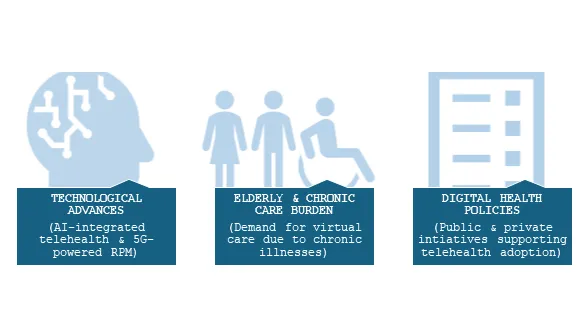
Telehealth solutions are witnessing significant advancements with technology integration, such as AI-powered symptom checkers, 5G-enabled RPM, and cloud-native consultation platforms, which enhance clinical workflows and reduce care delivery costs.
AI is rapidly becoming the backbone of virtual care models, supporting wide applications from administrative workflows to clinical monitoring and personalised decision support. This is enabling a shift from reactive teleconsultations to continuous, intelligent, and preventive virtual care ecosystems.
There is an accelerating demand for telehealth in acute and chronic care. Over 40% of Europeans live with ≥1 chronic condition, and the increasing ageing population adds to chronic care demand and puts pressure on hospitals. RPM and telehealth platforms offer expansion of acute care without adding physical capacity to address crowding in emergency departments and ICU units.
The current state of Telehealth in Europe
The European telehealth market is expected to grow at a strong 20.2% CAGR through 2030, supported by favorable digital health policies, technological innovations, and demographic needs, and the region is well-positioned for scalable telehealth adoption. Post-COVID-19 pandemic, telehealth adoption has become mainstream to cater to the increasing demand for accessible care with an aging population and a chronic disease burden. Owing to this, the majority of European countries witnessed active use of virtual care and remote patient monitoring (RPM) and have incorporated telehealth into their national digital health strategies.
Key Factors Driving Transition From Reactive to Intelligent, Preventive, and Personalised Virtual Care
Challenges and Restraints
Despite its promising potential, telehealth faces several barriers to widespread adoption:
Diverse regulatory frameworks across regions in the European telehealth landscape lead to challenges in cross-border service delivery. Moreover, while improving, a significant variation in reimbursement frameworks across countries in Europe creates market fragmentation and poses barriers for the wider implementation of telehealth.
While telehealth offers numerous promising benefits, it also demands prerequisites of awareness about digital modes of communication, devices, as well as access to reliable internet and smartphone infrastructure. Disparities in digital literacy and access to technology can hinder the adoption of telehealth.
Although compliance, such as the General Data Protection Regulation (GDPR), ensures safety and privacy of patient data, it may create challenges related to cost and complexity for smaller providers or vendors; limitations in processing and secondary usage of data, and regulatory uncertainty for Telehealth services that involve third-country vendors, such as US-based cloud service providers.
Regional Outlook
Telehealth in Europe is evolving from niche pilots to nationalised, reimbursed, and scaled models across all care types. The Nordic region leads with supportive regulation, reimbursement, and public initiatives. Nordics are advanced adopters with nationally funded and digitised healthcare, and their maturity is driven by unified digital ecosystems, nationwide infrastructure, and societal trust, which is ideal for scalable telehealth models across care domains. UK telehealth is consumption-driven, with policymakers backing integrated virtual ward models across all care settings. Success hinges on ICS-level coordination, outcome-based funding (e.g., admissions avoided), and strong digital infrastructure. Among other regions, Germany and France show balanced growth potential, Benelux performs well in regulatory and pilot project execution, and Spain and Italy face more implementation and funding hurdles despite demographic readiness.
Growth Opportunities and Future Outlook –
Europe is experiencing a profound demographic shift, with over 94 million people aged 65 and older, and this number is expected to exceed 130 million by 2050. The growing elderly population is more susceptible to chronic conditions, functional decline, and hospital readmissions, increasing the pressure on national health systems. Telehealth vendors should tap into growth opportunities such as remote monitoring for post-discharge transitional care, especially for the elderly recovering from surgery, stroke, or heart failure, and chronic disease management in home settings.
RPM and virtual consultation solutions are driving the transformation of traditional healthcare, leading to the shift of care from hospitals to homes and supporting various home-based care routes, including home care/aging-in-place facilities, nursing agencies, and hospital-at-home programs. It will be imperative for health systems to integrate across these settings and enable a seamless patient care journey. Partnerships will be critical among hospitals, payers, retail, and tech giants as the future is not about hospital versus home versus retail but about creating a patient-centric connected ecosystem enabling care from anywhere.
The emergency care system in Europe faces a significant patient volume, ranging around ~130 million patient visits to emergency departments annually. Tele-emergency services can bridge the gap in remote areas where immediate medical expertise is scarce. By triaging non-critical cases remotely, telehealth can decrease unnecessary hospital visits. Real-time communication between paramedics and remote physicians can expedite decision-making and treatment initiation.
The European region is witnessing a growing emphasis on patient-centric, data-driven, and value-based healthcare, aiming to deliver the best possible patient care while efficiently utilising resources and maintaining cost-effectiveness. Telehealth helps enhance VBC metrics through coordinated patient care with reduced travel time and cost, faster care delivery, and efficient hospital workforce utilisation, leading to quality care delivery.
Conclusion
Europe is undergoing a strategic shift in its telehealth landscape, mainly driven by demographic urgency, policy support, and digital health innovation. Telehealth in Europe has evolved from small pilots to a mainstream care delivery model, accelerated by the pandemic. As health systems grapple with workforce shortages, rising chronic disease burden, and an ageing population, telehealth is becoming integral to sustainable and patient-centered healthcare. Despite regional disparities, data challenges, regulatory and digital barriers, its long-term potential lies in enabling decentralised, value-based, and equitable care across the region, established as a strong pillar in the continent’s healthcare future. For vendors and healthcare systems alike, the next frontier lies in building interoperable, AI-powered, and patient-centric platforms that scale across borders and care settings. Ultimately, telehealth is no longer an adjunct to traditional healthcare in Europe. It is becoming a cornerstone of a more resilient, patient-centric, and data-driven system designed to meet the needs of future generations.

Sagar Mukhekar is an Industry Analyst at Frost & Sullivan. With over nine years of experience in healthcare and life sciences, he helps healthcare innovators through strategic market research, opportunity assessment, and competitive analysis across digital health, medical devices, and diagnostics, enabling clients to identify market opportunities and drive growth strategies.