
From Digital Adoption to Digital Transformation: Building AI-Ready and Sustainable Healthcare Organisations in Europe
More Than Digital Adoption: Preparing Hospitals for the AI Era
Haja Naina Mohamed, Researcher, York St John University, London Campus MSc in Global Healthcare Management
Eusropean hospitals continue to invest in digital technologies, yet digital adoption alone does not ensure organisational transformation. As artificial intelligence becomes integrated into healthcare and the EU AI Act introduces new governance requirements, organisational readiness has become increasingly important. This article presents a framework-led narrative synthesis combining NASSS, the Healthcare AI Governance Readiness Assessment (HAIRA), and the EU AI Act. The findings suggest that governance and workforce capability are more critical than technology alone in supporting sustainable AI-ready healthcare organisations.
Across Europe, hospitals have made significant progress in digitising services, improving interoperability, and adopting data-driven technologies. Electronic health records, decision-support systems, predictive analytics, and AI-enabled applications are gradually becoming part of everyday healthcare delivery. While these developments have strengthened digital capability, they have not always resulted in lasting organisational transformation. Technology implementation and organisational readiness do not necessarily progress at the same pace, creating a gap between digital adoption and sustainable change.
This distinction has become increasingly important for healthcare management. AI implementation requires more than sophisticated technology or modern infrastructure. It introduces new organisational responsibilities relating to governance, leadership, workforce capability, risk management, transparency, and regulatory compliance. As healthcare organisations prepare for wider AI deployment, understanding these organisational dimensions becomes essential for ensuring that digital investments translate into meaningful improvements in patient care and operational performance.
Rather than asking how hospitals can adopt more technology, healthcare leaders are increasingly asking a different question: what organisational conditions enable AI readiness to become sustainable digital transformation? Current evidence suggests that the answer lies less in technology itself than in the governance structures and workforce capabilities that support its successful implementation.
Looking beyond digital maturity
Digital maturity has become one of the most widely used approaches for evaluating healthcare organisations' progress in digital transformation. Existing maturity models typically assess technological infrastructure, information systems, digital connectivity, and implementation capability. These assessments have helped hospitals benchmark progress and identify areas requiring further technological investment.
However, existing evidence suggests that digital maturity models provide only part of the picture. Systematic reviews consistently show that technological infrastructure is among the most-developed dimensions within hospitals, while communication, workforce capability, and governance remain comparatively underdeveloped. In addition, the maturity-model literature itself applies inconsistent constructs across numerous frameworks, making it difficult to assume that higher maturity scores necessarily indicate organisational readiness for AI-specific governance requirements.
Evidence relating specifically to AI implementation reinforces this distinction. Studies examining AI adoption in healthcare repeatedly identify organisational rather than purely technical determinants as the primary drivers of successful implementation. Governance structures, leadership engagement, workforce capability, and organisational support consistently emerge as the factors influencing whether AI technologies become successfully embedded within routine hospital practice. Technology may provide the necessary infrastructure, but sustainable transformation depends on how organisations manage change around that technology.
National evidence from Germany illustrates this pattern particularly well. The DigitalRadar programme, covering approximately 91% of German hospitals, found that infrastructure and administrative systems consistently achieved higher levels of maturity than patient-facing services and process-related capabilities. Hospital leaders participating in the programme associated these differences with limitations in governance capacity and workforce readiness rather than shortcomings in technological infrastructure. These findings suggest that hospitals often possess the technical capability to support digital transformation but continue to face organisational challenges when translating technology into sustainable operational change.
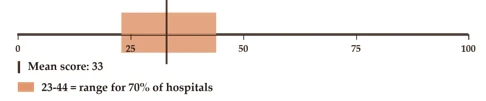
Figure 1. The Digital data range radar.
Credit: © (Geissler et al., 2024), Health Policy and Technology, 13(4), 100904.
Comparable large-scale evidence from other European healthcare systems was not identified within the reviewed literature. This highlights an important gap in current knowledge and suggests that digital maturity, as presently measured, remains an incomplete indicator of organisational AI readiness. Instead, governance and workforce capability should be considered analytically distinct from technological infrastructure when assessing an organisation's preparedness for AI-enabled healthcare.
From digital maturity to AI readiness
The transition from digital adoption to AI readiness requires hospitals to move beyond technology-centred assessment models and adopt a broader organisational perspective. AI systems influence clinical decision-making, operational processes, patient safety, regulatory compliance, and organisational accountability in ways that traditional digital technologies often did not.
As a result, healthcare organisations require governance arrangements capable of managing these additional responsibilities throughout the AI lifecycle. Leadership must establish clear accountability for implementation, ensure appropriate oversight of AI-supported decision-making, maintain transparency, and develop organisational processes that support responsible innovation. Workforce capability also becomes increasingly important, as clinicians and healthcare professionals require the confidence, knowledge, and organisational support necessary to integrate AI into everyday practice.
Current evidence therefore suggests that AI readiness should not be understood simply as technological capability. Instead, it represents the interaction between technology, governance, leadership, workforce preparedness, and long-term organisational sustainability. This broader perspective provides a stronger foundation for understanding why some digital transformation programmes achieve lasting organisational impact while others remain limited to technology deployment alone.
Building AI-ready healthcare organisations
To better understand these organisational requirements, the literature brings together three complementary perspectives that collectively provide a more comprehensive view of AI readiness within healthcare organisations. Rather than proposing an entirely new model, this synthesis integrates established implementation science, AI governance, and European regulatory requirements into a practical framework for healthcare management.
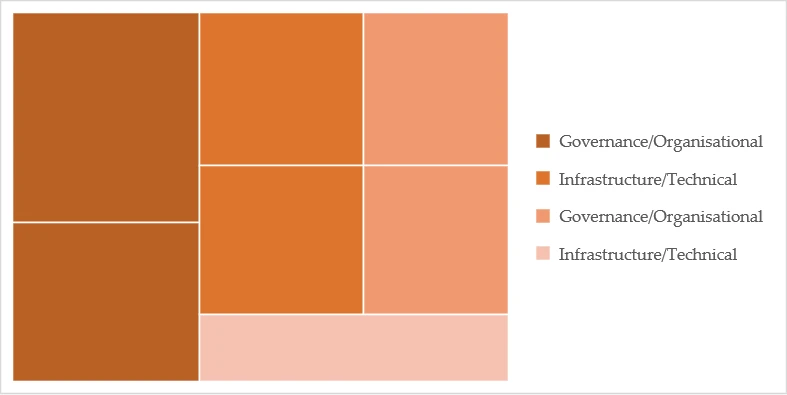
Figure 2. Tree map of category converges
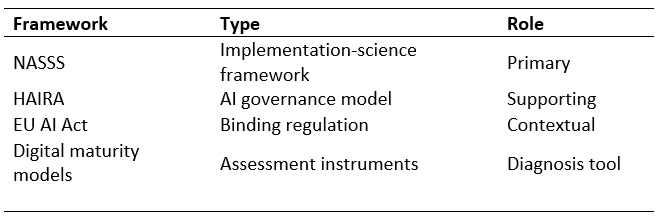
Three complementary perspectives help explain why successful AI implementation depends on far more than technological capability. The first is the Non-adoption, Abandonment, Scale-up,
Table 1. Framework comparison
Source: Table by Author
Spread and Sustainability (NASSS) framework, which provides the primary implementation-science perspective. Rather than focusing exclusively on technology, NASSS considers the organisational conditions that influence whether innovation becomes embedded and sustained. Within the context of this article, particular attention is given to three domains: the organisation domain, which considers leadership and governance capacity; the adopter-system domain, which examines workforce roles and skills; and the sustainability domain, which focuses on long-term organisational change.
While NASSS offers an established implementation framework, it predates many of today's AI-specific governance requirements. To address this, the Healthcare AI Governance Readiness Assessment (HAIRA) provides additional detail by identifying governance domains that are particularly relevant to artificial intelligence. Although its evidence base is currently concentrated largely within the United States and has yet to be extensively validated in European hospitals, HAIRA offers practical insight into what organisational AI governance should encompass beyond traditional digital transformation programmes.
The third perspective is provided by the European Union AI Act, which establishes the regulatory context surrounding AI implementation. Rather than functioning as an organisational framework, the regulation introduces legally binding obligations for many high-risk AI applications used within healthcare. These include requirements relating to risk management, data governance, human oversight, and technical documentation. Together, these three perspectives illustrate that AI readiness should be understood as an interaction between implementation science, organisational governance, workforce capability, and regulatory compliance, rather than as a measure of technological maturity alone.
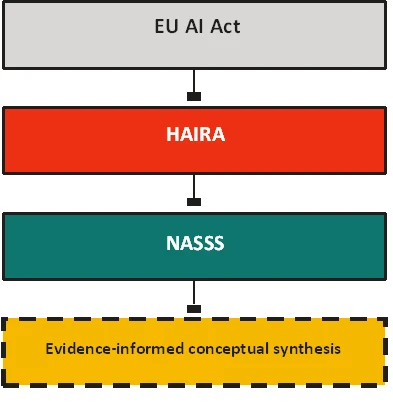
Source: Figure by author
Figure 3. Integrated synthesis of framework
What the evidence shows
The evidence reviewed in this article represents a purposive, framework-led synthesis rather than a systematic review. Consequently, it does not attempt to quantify findings through study counts or statistical comparisons. Instead, it examines how the available literature aligns with the proposed conceptual framework and identifies the organisational factors most consistently associated with sustainable digital transformation.
Across the reviewed literature, the strongest support exists for the organisational and sustainability domains described within the NASSS framework. Evidence from digital maturity reviews and national assessment programmes consistently indicates that technological capability often develops more rapidly than organisational capability. This imbalance helps explain why hospitals with advanced digital infrastructure may still experience difficulties embedding AI into routine practice. Sustainable transformation depends not only on technology but also on leadership structures, governance arrangements, organisational learning, and workforce preparedness.
Support for AI-specific governance, however, remains comparatively limited. While HAIRA provides a structured approach for understanding governance readiness and the EU AI Act establishes an important regulatory framework, the current literature offers only conceptual support for these domains. No study identified within this review demonstrates that governance readiness, as currently defined, directly predicts successful digital transformation outcomes within European hospitals. This represents one of the clearest evidence gaps highlighted by the available research.
Implications for healthcare leaders
The findings presented here suggest that European hospitals should broaden the way they evaluate digital transformation. Measuring technological capability alone provides only a partial picture of organisational readiness. Governance structures, leadership engagement, workforce capability, and organisational sustainability should be assessed alongside digital infrastructure to create a more balanced understanding of AI readiness.
For healthcare leaders, this means placing greater emphasis on governance arrangements that define accountability, establish appropriate oversight, and support responsible AI implementation. Workforce development should also become a strategic priority, ensuring that healthcare professionals possess the skills and confidence required to integrate AI safely and effectively into everyday practice. Organisational sustainability should remain a continuous objective rather than an outcome assumed to follow technology adoption automatically.
The synthesis presented here therefore redirects healthcare management attention towards the organisational conditions that support AI implementation. Rather than viewing governance and workforce capability as secondary considerations, the evidence suggests they are central to achieving sustainable digital transformation across European healthcare organisations.
From digital adoption to sustainable transformation
Digital adoption should not be mistaken for digital transformation. While hospitals continue to invest in technology, the evidence reviewed here indicates that sustainable organisational change depends on governance structures, workforce capability, and leadership capacity rather than infrastructure alone. AI readiness requires organisations to create the conditions that allow technology to be implemented responsibly, effectively, and sustainably.
The framework presented in this article should therefore be understood as an evidence-informed conceptual synthesis rather than a validated predictive model. By bringing together NASSS, HAIRA, and the EU AI Act, it offers healthcare leaders a broader perspective on organisational AI readiness while recognising that further empirical testing remains necessary. Future research should extend the evidence beyond Germany and examine more directly how governance and workforce conditions influence sustainable transformation outcomes across European healthcare systems.
Questions for healthcare leadership
- As hospitals continue preparing for AI-enabled healthcare, leadership teams may find it useful to consider several strategic questions.
- Does the organisation evaluate AI readiness through governance and workforce capability as well as technological infrastructure?
- Are leadership structures equipped to provide effective oversight throughout the AI implementation lifecycle?
- Does the workforce possess the skills, confidence, and organisational support required to integrate AI into everyday healthcare delivery?
- Finally, are governance arrangements sufficiently robust to meet evolving European regulatory requirements while supporting long-term organisational sustainability?
Answering these questions may prove just as important as investing in the next generation of digital technologies. Sustainable transformation depends not simply on adopting AI, but on creating the organisational conditions that allow innovation to deliver lasting value for patients, professionals, and healthcare systems alike.
References
- Burmann, A., Fischer, B., Brinkkötter, N., & Meister, S. (2022). Managing directors’ perspectives on digital maturity in German hospitals—A multi-point online-based survey study. International Journal of Environmental Research and Public Health, 19(15), 9709. https://doi.org/10.3390/ijerph19159709
- Duncan, R., Eden, R., Woods, L., Wong, I., & Sullivan, C. (2022). Synthesizing dimensions of digital maturity in hospitals: Systematic review. Journal of Medical Internet Research, 24(3), e32994. https://doi.org/10.2196/32994
- Geissler, A., Hollenbach, J., Haring, M., Amelung, V. E., Thun, S., & Haering, A. (2024). A nationwide digital maturity assessment of hospitals – Results from the German DigitalRadar. Health Policy and Technology, 13(4), 100904. https://doi.org/10.1016/j.hlpt.2024.100904
- Greenhalgh, T., Robert, G., Macfarlane, F., Bate, P., & Kyriakidou, O. (2004). Diffusion of Innovations in Service Organizations: Systematic Review and Recommendations. The Milbank Quarterly, 82(4), 581–629. https://doi.org/10.1111/j.0887-378X.2004.00325.x
- Hussein, R., Zink, A., Ramadan, B., Howard, F. M., Hightower, M., Shah, S., & Beaulieu-Jones, B. K. (2026). Advancing healthcare AI governance through a comprehensive maturity model based on systematic review. Npj Digital Medicine, 9, 236. https://doi.org/10.1038/s41746-026-02418-7
- Kamel Rahimi, A., Pienaar, O., Ghadimi, M., Canfell, O. J., Pole, J. D., Shrapnel, S., van der Vegt, A. H., & Sullivan, C. (2024). Implementing AI in hospitals to achieve a learning health system: Systematic review of current enablers and barriers. Journal of Medical Internet Research, 26, e49655. https://doi.org/10.2196/49655
- Kim, G. J., & Namkoong, K. (2025). Developing the digital health communication maturity model: Systematic review. Journal of Medical Internet Research, 27, e68344. https://doi.org/10.2196/68344
- Liaw, S.-T., & Godinho, M. A. (2023). Digital health and capability maturity models—A critical thematic review and conceptual synthesis of the literature. Journal of the American Medical Informatics Association, 30(2), 393–406. https://doi.org/10.1093/jamia/ocac228
- Regulation (EU) 2024/1689 Laying down Harmonised Rules on Artificial Intelligence (Artificial Intelligence Act), Official Journal of the European Union (2024). https://eur-lex.europa.eu/eli/reg/2024/1689/oj/eng

Haja Naina Mohamed is a Researcher at York St John University, London Campus, and holds an MSc in Global Healthcare Management. His research focuses on digital transformation, AI governance, operations, health equity, and sub-national governance. He is a co-author of an MDPI chapter, and his poster abstract was accepted for presentation at the 2026 FMLM National Conference in Liverpool.