
Is CT Angiography Safe? Radiation Risk & Contrast Dye Explained
Kate Williamson, Editorial Team, European Hospital & Healthcare Management
Is a CTA scan safe? Yes, for most patients. This article breaks down CT angiography radiation exposure in plain terms, compares it to everyday radiation sources, and explains iodine contrast dye side effects — from mild reactions to rare kidney concerns — so you know exactly what to expect before your scan.
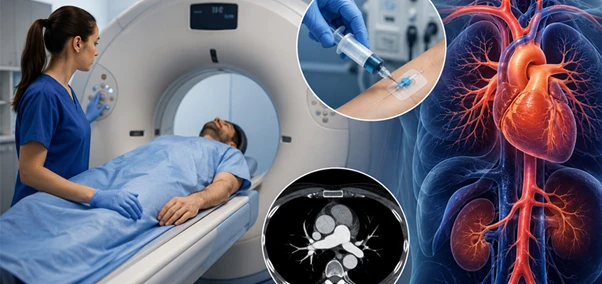
Is CT Angiography Safe? Radiation Risk & Contrast Dye Explained
If your doctor just ordered a CT angiogram, you probably have one big question rattling around your head: is this actually safe?
It's a fair question. You're about to get a scan that involves both radiation and an injected dye, and nobody loves the idea of either one. The good news is that CT angiography (CTA) has been used for decades, it's backed by a mountain of research, and for the vast majority of people, the benefits far outweigh the risks. But "mostly safe" isn't the same as "risk-free," so let's actually walk through what's happening inside that machine and why doctors trust it.
What Is a CT Angiogram, Exactly?
A CT angiogram is a specialized CT scan that images your blood vessels — usually to check for blockages, aneurysms, blood clots, or narrowing in the arteries around your heart, brain, lungs, or legs. It combines two things: a CT scanner (which uses X-rays) and an iodine-based contrast dye injected into a vein to make your blood vessels show up clearly on the images.
Doctors reach for CTA because it's fast, non-invasive, and gives incredibly detailed pictures without the need for a surgical catheter procedure. That's a huge upgrade from older diagnostic angiography methods.
Is CTA Scan Safe? The Short Answer
Yes — CT angiography is considered safe for the overwhelming majority of patients when it's medically necessary and performed correctly. The two main safety concerns people ask about are:
- Radiation exposure from the CT scan itself
- Side effects from the iodine contrast dye
Both risks are real, but both are also well understood, closely monitored, and small compared to the diagnostic value the scan provides. Let's break each one down.
CT Angiography Radiation Exposure: How Much Is It Really?
Here's the part that scares people the most, and honestly, it's the part most misunderstood.
A CT angiogram does expose you to ionizing radiation, and the dose is higher than a standard X-ray. Depending on the body part being scanned, a CTA typically delivers somewhere between 5 to 15 millisieverts (mSv) of radiation. For comparison:
- A chest X-ray: about 0.1 mSv
- Natural background radiation (from soil, air, cosmic rays) you absorb every year just by living on Earth: about 3 mSv
- A coronary CT angiogram: roughly 5–10 mSv, though newer low-dose scanners can bring this down significantly
- A full-body CT scan: can reach 10–20 mSv
So a single CTA is roughly equivalent to 1 to 5 years' worth of natural background radiation. That sounds like a lot when you say it out loud, but the actual increase in lifetime cancer risk from a single scan is very small — generally estimated at well under 1%.
Why Radiation Dose Varies
Not every CTA delivers the same dose. It depends on:
- Which body part is scanned (a head CTA uses less radiation than a full aorta scan)
- The scanner technology — newer machines use dose-reduction software that can cut exposure by 50% or more compared to older equipment
- Patient size — larger bodies sometimes require slightly higher doses for clear images
- Number of scan phases — some protocols take multiple passes, which adds dose
Radiology departments follow a principle called ALARA — "As Low As Reasonably Achievable." Technologists are trained to use the minimum radiation needed to get a diagnostic-quality image, not the maximum the machine can produce.
Who Should Be Extra Cautious About Radiation?
- Pregnant women — CT scans are generally avoided unless absolutely necessary, and alternative imaging is considered first
- Children — kids are more radiation-sensitive than adults, so pediatric protocols use significantly lower doses
- Patients needing repeated scans — if you're getting frequent CTAs over months or years, cumulative dose becomes a more relevant conversation with your doctor
If you fall into one of these groups, it's worth directly asking your radiologist about dose-reduction protocols or alternative imaging like MRI or ultrasound, which don't use ionizing radiation at all.
Iodine Contrast Dye Side Effects: What to Actually Expect
The second half of the safety question is the contrast dye — and this is actually where most of the noticeable reactions come from, not the radiation.
Iodine-based contrast is injected through an IV right before or during the scan. It travels through your bloodstream and lights up your vessels on the images. Most people feel completely fine. Some feel a little strange for a few minutes. A small number have a genuine reaction.
Mild, Common Side Effects (Most Patients)
- A warm, flushing sensation spreading through the body
- A metallic taste in the mouth
- Mild nausea
- A brief feeling of needing to urinate
These usually pass within a minute or two and don't need any treatment.
Moderate Reactions (Less Common)
- Hives or itching
- Vomiting
- More persistent nausea
- Mild swelling
These happen in a small percentage of patients and are typically managed easily with antihistamines or by simply monitoring the patient for a bit longer.
Severe Reactions (Rare)
- Difficulty breathing
- Significant drop in blood pressure
- Severe allergic reaction (anaphylaxis)
Severe reactions occur in a very small fraction of a percent of contrast injections. Imaging centers are equipped and staffed to handle these immediately if they happen, which is part of why you're monitored closely during and right after the injection.
Contrast-Induced Kidney Concerns
One of the more talked-about risks is contrast-induced nephropathy — a temporary decline in kidney function that can occur after contrast dye exposure, particularly in people who already have reduced kidney function, diabetes, or dehydration.
For most healthy patients, this isn't a significant concern. But if you have known kidney disease, your doctor may:
- Check your kidney function (creatinine/eGFR) before the scan
- Have you hydrate well before and after
- Use a lower dose of contrast or an alternative imaging method
- Temporarily pause certain medications like metformin
Who's at Higher Risk for Contrast Dye Side Effects?
- People with a prior allergic reaction to iodine contrast
- Patients with chronic kidney disease
- People with asthma or multiple drug allergies
- Patients with hyperthyroidism (iodine can affect thyroid function)
- Those who are significantly dehydrated
If any of this applies to you, tell your radiology team beforehand. They may premedicate you with steroids/antihistamines or choose a different diagnostic approach entirely.
Weighing the Risk Against the Benefit
Here's the perspective that tends to get lost: doctors don't order a CTA just to see what happens. It's typically requested because there's a real concern — chest pain, suspected clot, aneurysm risk, stroke symptoms — where not knowing what's going on inside your vessels carries its own serious risk.
A missed blood clot, an undetected aneurysm, or an unseen coronary blockage can be far more dangerous than the small, well-managed risks of a single CT angiogram. That's the trade-off your doctor is weighing when they order the test.
Frequently Asked Questions
Is a CTA scan safe for someone with kidney disease?
It can be, but it requires precautions. Your doctor will likely check kidney function beforehand, ensure you're well hydrated, and may adjust the contrast dose or choose an alternative imaging test if your kidney function is significantly reduced.
How much radiation does a CT angiogram give you compared to a normal CT?
A CTA generally delivers a similar or slightly higher dose than a standard CT scan of the same body region, roughly 5–15 mSv depending on the area scanned and the scanner's technology.
Can you be allergic to CT contrast dye?
Yes. Allergic reactions range from mild hives to rare severe anaphylaxis. If you've reacted to contrast dye before, tell your care team — they can premedicate you or use an alternative.
Does CT angiography increase cancer risk?
A single CTA carries a very small theoretical increase in lifetime cancer risk from radiation exposure, generally considered negligible for most patients. The risk becomes more relevant with frequent, repeated scans over time.
Is CTA safer than a traditional catheter angiogram?
In terms of invasiveness, yes — CTA doesn't require threading a catheter through your arteries, which removes risks like bleeding, vessel injury, or infection at the catheter site. It does still involve radiation and contrast dye.
The Bottom Line
CT angiography is a well-established, closely regulated procedure, and for the vast majority of patients, it's safe. The radiation dose is carefully controlled, and any contrast dye side effects are usually mild and short-lived. Serious complications are rare, and imaging centers are prepared to handle them when they do occur.
If you have specific risk factors — kidney issues, contrast allergies, thyroid conditions, or pregnancy — have an honest conversation with your doctor before the scan. That conversation is really what safety comes down to: making sure the right precautions are in place for your situation, not just following a one-size-fits-all protocol.

Kate, Editorial Team at European Hospital & Healthcare Management, leverages her extensive background in Healthcare communication to craft insightful and accessible content. With a passion for translating complex Healthcare concepts, Kate contributes to the team's mission of delivering up-to-date and impactful information to the global Healthcare community.