
Pharmacomicrobiomics: When a Bug Meets a Drug
Dr. Paras Shah, Junior Resident, Pharmacology, New Civil Hospital & Government Medical College
Pharmacomicrobiomics explores how gut microbiota influence drug metabolism, efficacy, and toxicity. Integrating microbiome data with pharmacogenomics enhances precision medicine by predicting individual drug responses. This evolving field uses advanced metaomic tools, offering new strategies for personalised therapies, minimising adverse reactions, and improving clinical outcomes across diverse therapeutic domains.
Introduction
Pharmacogenomics is a key area in precision medicine.[1] Initially, it focused on genetic variations to predict drug responses and toxicity.[2] However, environmental and disease factors also play a crucial role, which leads to the development of pharmacomicrobiomics.[3] This field explores how the microbiome affects drug response and disposition, which further enhances models of drug behaviour in the body.[4] The microbiome is also known as the “second genome”, which is a complex ecosystem in the gut with over 100 trillion cells and 5 million genes.[5] It involves major phyla like Firmicutes and Bacteroidetes. Additionally, it is vital for metabolism, immune function and mood regulation. It also influences drug pharmacokinetics and pharmacodynamics, which in turn causes interindividual variations in drug metabolism, efficacy, and toxicity.[6] Pharmacomicrobiomics has the potential to revolutionise precision medicine by profiling individual microbiomes to predict drug responses, improving treatment efficacy and reducing adverse reactions. The dynamic microbiome can be modulated through diet, probiotics, prebiotics and antibiotics, which offers opportunities to correct unfavourable drug-microbiome interactions and optimise personalised treatments.[6]
Process of Drug Metabolism
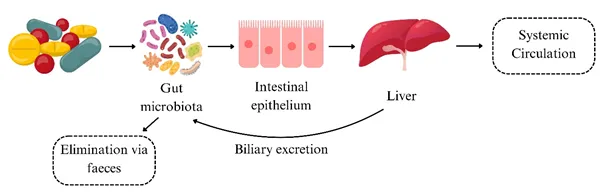
After oral administration, drug moves through the stomach and small intestine before reaching the colon, where they encounter a vast community of gut microbes. Drugs mainly affect microbiome in large intestine. The gut microbiome can also transform drugs chemically. Usually, drug metabolism primarily occurs in the liver. However, gut bacteria perform different chemical modifications, primarily hydrolytic and reductive reactions, unlike the liver’s oxidative and conjugative reactions.[7] After metabolism (Fig. 1), drug metabolites are either transported to target tissues or excreted by the kidneys or liver. In the gut, drugs or metabolites may undergo further bacterial metabolism and reabsorption.[8] This complexity necessitates a systems biology approach in pharmacological studies to consider both hepatic and bacterial metabolic processes, as well as host-microbe-drug interactions.
Genetics-Diet Interaction
Pharmacomicrobiomic studies must account for the complexity of the gut microbiome, which is influenced by host genetics, environmental factors, and their interactions. Genome-wide association studies (GWAS) have linked microbial composition to genetic variants involved in immunity, metabolism, and digestion. Diet, a key external factor, directly impacts gut microbes—high-fibre diets support microbial diversity, while Western diets reduce it. Moreover, bioactive dietary compounds can interact with drugs, creating a triad of influences—genetics, microbiota, and environment—that collectively shape drug metabolism.[9]
Approaches in Pharmacomicrobiomics
In pharmacomicrobiomics, various metaomic approaches are utilised. Metagenomics is the most common method for studying the intestinal microbiome.[10] It analyses the genetic material of the gastrointestinal microbiota but is limited to genes, which actually hinders a full understanding of microbiota functions. Approaches like metatranscriptomics, which studies gene expression and metaproteomics, which examines proteins, have been developed to delve deeper into microbiota-host interactions. Common techniques in pharmacomicrobiomics include:
- Culture-dependent methods
- e.g. Bacterial culture and gnotobiotic animals
- Culture-independent methods
- e.g. Next‑generation sequencing—16S rRNA gene profiling for bacteria and internal transcribed spacer sequencing for fungi—alongside shotgun metagenomics, metatranscriptomics (RNA‑seq), metaproteomics, and metabolomics.
These techniques are potentially altering the interpretation of many diseases due to their limitations in detecting disease.[11]
Influence of the Gut Microbiome on Drug Effectiveness and Toxicity
The gut microbiome plays an important role in drug efficacy and toxicity by transforming drugs through microbial enzymes. These enzymes can activate or inactivate them. It also affects immune function and modulates drug-metabolising enzymes and transporters via metabolites like Short chain fatty acids (SCFAs), which further enhances regulatory T-cell function and reduces inflammation.[12] Microbial molecules such as lipopolysaccharides can activate immune cells by altering drug metabolism. Additionally, some drugs bioaccumulate in the gut. This impacts their availability and efficacy. These interactions highlight the microbiome’s importance in drug responses, which necessitates its consideration in personalised medicine to optimise outcomes and reduce adverse drug reactions. The microbiota modulates enterohepatic circulation, impacting drug metabolism, absorption, recycling, and systemic circulation. Benefits of such properties can be explained through several examples:
A. Gut microbiome and Proton pump inhibitors (PPIs)
PPIs treat acid-related disorders like GERD by altering gut microbiota via pH-dependent and independent mechanisms. Reduced stomach acidity weakens the gastric barrier, allowing oral microbes to colonize the gut and increasing the risk of infections like Clostridium difficile.[13] PPI use alters the microbiome similarly to C. difficile infections, with increased Streptococcus and Enterococcus and reduced Clostridiales. Additionally, PPIs may accelerate endothelial senescence, though the gut microbiome’s role in this is unclear.[14] The significant negative impact of PPIs on the microbiome has sparked discussions about restricting their over-the-counter availability.[15]
B. Gut microbiome and the cell cycle-specific chemotherapy
Evidence from various studies shows that drugs significantly impact the gut microbiome, which affects the efficacy and toxicity of anticancer drugs. Gut bacteria like Bacteroides fragilis and Erysipelotrichaceae are crucial for enhancing immune responses to platinum-based drugs such as oxaliplatin and cisplatin by boosting dendritic cell activity and CD8+ T-cell function. Metabolites like short-chain fatty acids, particularly butyrate, improve oxaliplatin’s efficacy by inhibiting histone deacetylases.[16] The anti-PD-L1 antibody works better with Bifidobacterium which further enhances dendritic cell function and CD8+ T-cell priming. 5-FU administration leads to dysbiosis, reducing Bacteroides and Streptococcus while increasing Lachnospiraceae and Clostridium hathewayi, potentially causing oral ulcers. Lactobacillus plantarum is emerging as a chemosensitizer for 5-FU.[17] Cyclophosphamide is more effective with Barnesiella intestinihominis and Enterococcus hirae, which support immune responses and lymphoid organ translocation. Other drugs like gemcitabine, capecitabine, 6-mercaptopurine, bleomycin, vinblastine, and vincristine also interact significantly with the microbiome.
C. Gut microbiome and the immunochemotherapy
The gut microbiota influences the effectiveness of immunochemotherapeutics. Mouse studies show that bacteria like Bacteroides fragilis and Bifidobacterium enhance antitumor responses, while human studies link specific strains, such as Faecalibacterium prausnitzii, to better outcomes in metastatic melanoma patients. Understanding these interactions could improve therapeutic strategies and personalised medicine. The gut microbiome can alter the pharmacokinetics of tacrolimus by producing microbiome-specific metabolites and affect mycophenolate’s enterohepatic recirculation by changing its systemic exposure.[18] Limited data exist on the microbiome’s impact on other immunosuppressants like cyclosporine A, corticosteroids, and sirolimus. Multiple ongoing researches are assessing the microbiome’s role in methotrexate response.
D. Gut microbiome and the Metformin
Metformin, which is used for diabetes mellitus, is shown to positively affect microbiota structure and function. It boosts bacteria producing short-chain fatty acids (SCFAs)[19], which may enhance its therapeutic effects. Metformin also raises the abundance of butyrate-producing bacteria and Akkermansia muciniphila. Faecal transplants from metformin-treated individuals enhanced glucose tolerance in germ-free mice.
E. Gut microbiome and the psychiatric drugs
Psychotropic drugs induce significant shifts in the gut microbiome of individuals with mood and psychotic disorders. Antidepressants differentially influence gut microbiota: duloxetine and paroxetine reduce alpha diversity in mice, whereas buspirone restores beta diversity in depression models.[20] The gut microbiota also modulates antidepressant bioavailability, as seen with duloxetine accumulation in Caenorhabditis elegans. The gut microbiome also influences the effectiveness of Alzheimer’s disease medications.
Emerging evidence suggests the gut microbiota influences responses to drugs like digoxin, ACE inhibitors, warfarin, and others by transforming them into metabolites. For example, Eggerthella lenta reduces digoxin to dihydrodioxin. Gut microbes modulate the metabolism of antihypertensives like amlodipine and nifedipine; characterizing these effects can refine dosing strategies and enhance treatment efficacy. This will lead to personalised treatments and future research opportunities.
The Pharmacomicrobiomics Portal
The Pharmacomicrobiomics Database aggregates and classifies documented drug–microbe interactions by body site and microbial taxonomy. It is accessible via a web portal (http://www.pharmacomicrobiomics.org) with a search engine. It links to public databases like PubMed, PubChem, and Comparative Toxicogenomics. This portal nurtures open‐science collaboration by integrating pharmacogenomic insights with human microbiome research. Additionally, multiple microbiome markers and drug-microbe associations tools (eg. Graph2MDA)[21] are being developed by reseaechers.
Challenges
Beyond bacteria, gut bacteriophages and fungi (e.g., Candida, Saccharomyces) drive horizontal gene transfer and express glycosidases/oxidoreductases, introducing additional drug modifications. These non‑bacterial actors complicate drug–microbe interaction studies and hinder accurate prediction of individual pharmacokinetic and pharmacodynamic profiles. However, predicting an individual’s response to a drug is crucial for personalised medicine. Advancing clinical applications requires understanding the mechanisms through a systematic approach that combines pharmacogenetics, pharmacogenomics, and pharmacomicrobiomics to study drug pharmacokinetics at an individual level. Integrating pharmacomicrobiomics into clinical practice faces challenges due to the microbiome’s variability. Microbiome composition shifts over time, which requires adaptive monitoring and dynamic models.[22] Large-scale clinical studies are needed to validate findings and create practical guidelines for healthcare providers.[6]
Such challenges need to be addressed thoroughly by encouraging interdisciplinary collaboration among pharmacologists, microbiologists and clinicians. Spreading awareness regarding pharmacomicrobiomics will result in upliftment of the field, healthcare delivery system, clinical outcomes and reduced ADRs.
Conclusion
Pharmacomicrobiomics is a promising tool in precision medicine. It highlights microbial strains that interact with drugs, using them as biomarkers to predict therapeutic outcomes and potential adverse drug reactions. By combining insights from pharmacogenomics and pharmacomicrobiomics, personalised drug therapy can be optimised, leading to improved patient outcomes and reduced healthcare costs. This approach minimises ineffective treatments and adverse drug reactions. Healthcare’s future involves harnessing the microbiome’s potential to improve human health.
References
- Chenchula S, Atal S, Uppugunduri CRS. A review of real-world evidence on preemptive pharmacogenomic testing for preventing adverse drug reactions: a reality for future health care. Pharmacogenomics J 2024;24(2):9.
- Eissenberg JC, Aurora R. Pharmacogenomics: What the Doctor Ordered? Mo Med 2019;116(3):217–25.
- Hooper LV, Gordon JI. Commensal Host-Bacterial Relationships in the Gut. Science 2001;292(5519):1115–8.
- Chen HQ, Gong JY, Xing K, Liu MZ, Ren H, Luo JQ. Pharmacomicrobiomics: Exploiting the Drug-Microbiota Interactions in Antihypertensive Treatment. Front Med 2022;8:742394.
- Aggarwal N, Kitano S, Puah GRY, Kittelmann S, Hwang IY, Chang MW. Microbiome and Human Health: Current Understanding, Engineering, and Enabling Technologies. Chem Rev 2023;123(1):31–72.
- Chenchula S, Atal S, Bhattacharyya A, Medhi B, Chavan M, Sarma P. Pharmacomicrobiomics – Another frontier of precision medicine. Indian J Pharmacol 2024;56(4):237–41.
- Koppel N, Maini Rekdal V, Balskus EP. Chemical transformation of xenobiotics by the human gut microbiota. Science 2017;356(6344):eaag2770.
- Stein A, Voigt W, Jordan K. Review: Chemotherapy-induced diarrhea: pathophysiology, frequency and guideline-based management. Ther Adv Med Oncol 2010;2(1):51–63.
- Zhernakova A, Kurilshikov A, Bonder MJ, Tigchelaar EF, Schirmer M, Vatanen T, et al. Population-based metagenomics analysis reveals markers for gut microbiome composition and diversity. Science 2016;352(6285):565–9.
- Dikeocha IJ, Al‐Kabsi AM, Miftahussurur M, Alshawsh MA. Pharmacomicrobiomics: Influence of gut microbiota on drug and xenobiotic metabolism. FASEB J [Internet] 2022 [cited 2025 Jun 26];36(6). Available from: https://onlinelibrary.wiley.com/doi/10.1096/fj.202101986R
- Wang X, Yuan W, Yang C, Wang Z, Zhang J, Xu D, et al. Emerging role of gut microbiota in autoimmune diseases. Front Immunol 2024;15:1365554.
- Wang S, Ju D, Zeng X. Mechanisms and Clinical Implications of Human Gut Microbiota-Drug Interactions in the Precision Medicine Era. Biomedicines 2024;12(1):194.
- Imhann F, Bonder MJ, Vich Vila A, Fu J, Mujagic Z, Vork L, et al. Proton pump inhibitors affect the gut microbiome. Gut 2016;65(5):740–8.
- Yepuri G, Sukhovershin R, Nazari-Shafti TZ, Petrascheck M, Ghebre YT, Cooke JP. Proton Pump Inhibitors Accelerate Endothelial Senescence. Circ Res [Internet] 2016 [cited 2025 Jun 26];118(12). Available from: https://www.ahajournals.org/doi/10.1161/CIRCRESAHA.116.308807
- Jackson MA, Goodrich JK, Maxan ME, Freedberg DE, Abrams JA, Poole AC, et al. Proton pump inhibitors alter the composition of the gut microbiota. Gut 2016;65(5):749–56.
- Vich Vila A, Collij V, Sanna S, Sinha T, Imhann F, Bourgonje AR, et al. Impact of commonly used drugs on the composition and metabolic function of the gut microbiota. Nat Commun 2020;11(1):362.
- Kaźmierczak-Siedlecka K, Bulman N, Ulasiński P, Sobocki BK, Połom K, Marano L, et al. Pharmacomicrobiomics of cell-cycle specific anti-cancer drugs – is it a new perspective for personalized treatment of cancer patients? Gut Microbes 2023;15(2):2281017.
- Mohamed ME, Saqr A, Staley C, Onyeaghala G, Teigen L, Dorr CR, et al. Pharmacomicrobiomics: Immunosuppressive Drugs and Microbiome Interactions in Transplantation. Transplantation 2024;108(9):1895–910.
- Doestzada M, Vila AV, Zhernakova A, Koonen DPY, Weersma RK, Touw DJ, et al. Pharmacomicrobiomics: a novel route towards personalized medicine? Protein Cell 2018;9(5):432–45.
- Brown LC, Bobo WV, Gall CA, Müller DJ, Bousman CA. Pharmacomicrobiomics of Antidepressants in Depression: A Systematic Review. J Pers Med 2023;13(7):1086.
- Deng L, Huang Y, Liu X, Liu H. Graph2MDA: a multi-modal variational graph embedding model for predicting microbe–drug associations. Bioinformatics 2022;38(4):1118–25.
- Le Ngoc K, Pham TTH, Nguyen TK, Huong PT. Pharmacomicrobiomics in precision cancer therapy: bench to bedside. Front Immunol 2024;15:1428420.

Dr. Paras Shah is currently pursuing his MD and has been actively involved in various research initiatives. He has received funding from prestigious government agencies, including the Indian Council of Medical Research (ICMR) and the National Tuberculosis Elimination Program–State Task Force (NTEP-STF), Gujarat. His key areas of interest include medical technology (MedTech), pharmaceuticals, and the integration of medicine with emerging and futuristic technologies.