
Reproductive Health Rights in Europe: A Country-by-Country Breakdown
Debi Jones, Editorial Team, European Hospital & Healthcare Management
People in Europe have different reproductive health rights based on cultural beliefs, religious and political systems. Western and Northern Europe are liberal about people’s reproductive rights, contraception, abortion, and teaching sexuality. On the other hand, Eastern and Southern Europe have more restrictive legal systems cultural barriers have also been recorded. Mainly what is required is advocacy and awareness of these rights.
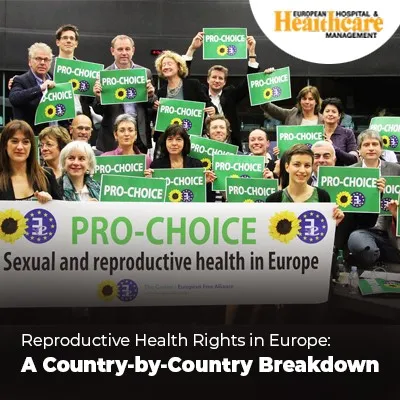
Introduction:
Reproductive health rights are very fundamental rights of women and men and are part of Gender Equality bills of human rights. Such rights differ throughout Europe, due to cultural, religious and political factors in each particular country. In this article, the current achievement, as well as the obstacles and inequalities concerning reproductive health rights in Europe, have been systematically discussed.
The Importance of Reproductive Health Rights
The overall concept to reproductive health is also inclusive of other aspects such as contraception, post abortion care, fertility and assisted reproductive technologies as well as sex education. These rights guarantees control of people over their bodies and ascertain their future amid uncertain circumstances. In Europe where the healthcare is almost sound, reproductive health rights are still on the sharper edge of the social and political agenda.
Western Europe: A Progressive Landscape
These countries of Western Europe are the most liberal in reproductive health rights, from the legislation adopted to access to services.

France
The survey demonstrated that France has the most extensive availability of both contraception and abortion. Abortions are allowed up to 14 weeks into pregnancy and to women are covered by the National Health System. Emergency contraception is over the counter. Education curriculums require schools to cover comprehensive and sex education based on choice and avoidance of STIs.
Germany
Germany permits abortions in cases where the pregnancy has not exceeded twelve weeks and the following must be designed: counseling, then a three-day waiting period. After 12 weeks of pregnancy an abortion is allowed only when there is medical or ethical reason to do so. Emergency contraceptives exist, but they don’t cost little and sometimes patients have to pay for them at least partially out of their pocket.
The Netherlands
The Netherlands is also recognized as progressive. Health care providers offering abortions are legally required to explain the procedure but may not impose any waiting period; abortions are allowed up to completion of 24 weeks of pregnancy. This awareness begins in schools with instructions on personal relationships and choices made on knowledge of the facts. This has led to the Netherlands to have low teenage pregnancy and other unwanted pregnancies.
Northern Europe: Leaders in Gender Equality
This article established that Northern European countries are among the leading countries in terms of gender equality and this is entails in reproductive health policies.
Sweden
Interestingly, the policies of Sweden are comparatively the most liberal. Abortion is legal up to 18 weeks gestation under no circumstances and beyond 18 weeks for medical reasons. Family planning and sexual reproductive rights education are promoted, with nearly free or cost-claimed services to the youths.
Norway
Like most developed countries Norway provide abortion up to 12 weeks of pregnancy with information about possibility of medical abortion in later weeks if necessary. The negative rates of teenage pregnancies are therefore minimized due to the governments continued emphasis on the education aspect and prevention.
Denmark
Both Denmark and Sweden have similar policies, and abortions up to 12 weeks can be performed in the country. Comprehensive Sexuality Education (CSE) is mandatory as it is well stipulated by the law across the school systems. The contraceptives are made easily available since the country’s health care system supports them.
Eastern Europe: A Mixed Picture
Situation in Eastern Europe is more diverse; reproductive health rights include cultural or religious legacy of the region quite often.
Poland
Currently, Poland ranks among the EU member states that allow the least number of abortions. Abortion is allowed only if the woman has been raped, or if she was raped incestuously or if the foetus is seriously malformed. Access to contraception and sexual education is limited, leading to higher rates of unintended pregnancies compared to Western Europe.
Hungary
Hungary allows abortions up to the 12th week of pregnancy, and the woman must receive counseling and have to wait 72 hours. New policies formulated by the government supports polygyny, this can affect reproductive health services in some ways. As for reproductive education, they are rare and frequently orientation based.
Czech Republic
The reproductive health rights in the Czech Republic are quite flexible; abortion is legal up to 12 weeks and contraception is free. Another school – based intervention is the provision of comprehensive sexual education to enable people make sound decisions.
Southern Europe: Striking a Balance
Many Mediterranean countries, therefore, have relatively liberal attitudes to policy-making but these remain rooted within a very devout environment.
Italy
Abortion is legal up to 12 weeks of pregnancy but General Medical Practitioner and conscientious objection mean that providers are less easy to find. More than 70 percent of gynecologists in Italy do not participate in the practice of voluntary abortions. There is availability of contraceptives but the culture has not encouraged free access for some women.
Spain
Abortion laws in Spain are among some of the most liberal in Southern Europe allowing the procedure up to the 14 weeks without exception. In many ways, access and investment in sexual education are still disadvantageously unequal across different locales.
Portugal
Portugal have made abortion legal in the year 2007, allowing it up to a period of ten weeks. But mandatory pre-counseling and the waiting period are obligatory. Hormonal contraceptives are easily accessible and many of them are even partially funded.
Challenges and Barriers
While Europe has made significant strides in reproductive health rights, challenges persist:
- Access Inequality: Since rural areas have many disadvantages in comparison with cities it may be considered that rural areas do not have the same opportunities to get services as cities.
- Cultural Stigma: In most cultures and religions, people are discouraged to discuss issues to do with reproductive health.
- Conscientious Objection: Clinicians choosing not to carry out abortions are thus hindrances, even in those jurisdictions with relatively permissive legislation.
- Political Shifts: Some countries have given rise to conservatism that challenges existing reproductive health rights.
The Role of Advocacy and Education
Advocacy organizations are very essential especially in the defense and of women reproductive health. Sex education is still a very powerful weapon in combating unwanted pregnancy amongst other relevant consequences.
Conclusion
Evaluating reproductive health rights in European countries involves a cataloging of gains made and barriers inherent in a number of parliaments.
Although industrialized countries are leaders in providing accessibility and inclusion, many states face the problem of punitive policies and conservative attitudes. Thus, Europe can further prolong its promotion of reproductive health rights establishing free speech, free choice of education as well as providing equal opportunities for any person in the state.

Debi Jones, part of the Editorial Team at European Hospital & Healthcare Management, draws on her deep experience in healthcare communication to produce clear and impactful content. Her dedication to simplifying intricate healthcare topics helps the team fulfill its goal of offering relevant and influential information to the international healthcare sector.