
Radiology, a cornerstone of modern medical diagnostics, is undergoing a profound transformation fueled by rapid advancements in artificial intelligence (AI). Traditionally reliant on the expert visual interpretation of medical images, radiology now integrates sophisticated AI algorithms that augment human perception, automate complex analytical tasks, and extract clinically relevant insights with unparalleled speed and accuracy. This evolution is driven by the increasing availability of high-quality imaging datasets, breakthroughs in machine learning (ML) and deep learning (DL), and the growing need for efficiency in medical imaging workflows.
This article explores the role of AI in radiology, detailing its core capabilities in advanced quantitative imaging, deep pattern recognition, and predictive analytics. We also discuss its impact on diagnostic accuracy, workflow optimization, and patient care, emphasizing that AI serves as a tool to enhance, rather than replace, the expertise of radiologists. Finally, we highlight the future trajectory of AI in radiology, advocating for a collaborative framework where machine intelligence and human expertise converge to advance precision medicine.
The Advent of Artificial Intelligence in Radiology
The integration of AI into radiology is not a recent phenomenon, but recent advancements in deep learning and neural networks have significantly accelerated its adoption. Traditional ML techniques relied on handcrafted feature extraction, whereas contemporary deep learning models leverage convolutional neural networks (CNNs) to autonomously learn hierarchical features from medical images. With access to extensive annotated datasets, these AI models achieve unprecedented accuracy in detecting and classifying pathologies.
AI’s ability to mitigate key challenges in radiology—such as inter-observer variability, cognitive fatigue, and high imaging volumes—positions it as a crucial asset in modern medical imaging. By providing automated, objective assessments, AI assists radiologists in reducing diagnostic errors, optimizing resource allocation, and improving clinical outcomes.
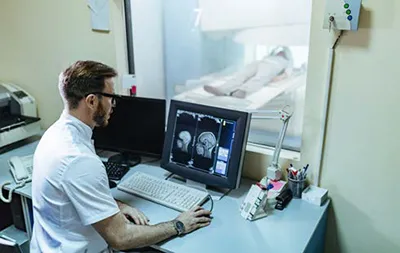
Key Capabilities of AI in Radiology
- Advanced Quantitative Imaging
Conventional radiology relies on subjective visual assessments, whereas AI-driven quantitative imaging extracts high-dimensional data to enhance objectivity. Techniques such as radiomics facilitate the extraction of a multitude of image-based biomarkers, providing insights into lesion characterization, tumor heterogeneity, and disease progression. These quantitative features, when integrated with ML algorithms, offer a more nuanced understanding of pathology beyond what is visually discernible.
Radiomics-driven approaches are particularly valuable in oncologic imaging, where AI can differentiate benign from malignant lesions, predict treatment response, and assess tumor recurrence risk. Moreover, AI-enhanced perfusion imaging and texture analysis contribute to more precise diagnostic and prognostic evaluations in neuroimaging and musculoskeletal radiology.
- Deep Pattern Recognition
AI excels in recognizing complex visual patterns within medical images, enhancing the detection of subtle abnormalities that may be overlooked by human observers. CNN-based models have demonstrated superior performance in detecting pulmonary nodules in CT scans, microcalcifications in mammograms, and ischemic lesions in brain MRIs. Automated segmentation algorithms further refine delineation of anatomical structures and pathological lesions, improving the accuracy of volumetric analyses and treatment planning.
In musculoskeletal imaging, AI aids in identifying fractures, cartilage degeneration, and soft tissue abnormalities with high precision. Similarly, AI-assisted cardiac imaging improves segmentation of ventricular structures, enabling more precise assessments of cardiac function and myocardial pathology.
- Predictive Analytics
Beyond diagnostic applications, AI leverages imaging biomarkers to predict disease progression, treatment response, and patient outcomes. Predictive models trained on multimodal datasets—combining imaging, genomic, and clinical data—facilitate personalized medicine by identifying patients at high risk for adverse outcomes.
For example, AI-driven analysis of tumor radiomic signatures can predict response to chemotherapy, guiding oncologists in selecting optimal treatment strategies. In neuroimaging, machine learning models identify early markers of neurodegenerative diseases, such as Alzheimer's, enabling timely interventions. Such predictive capabilities pave the way for AI-integrated precision medicine approaches, tailoring treatments to individual patient profiles.
Enhancing Diagnostic Accuracy and Efficiency
- Improved Diagnostic Accuracy
AI serves as a "virtual second reader," enhancing radiologists’ ability to detect abnormalities and reducing false-negative rates. Studies have demonstrated AI's potential to achieve diagnostic performance comparable to expert radiologists in certain imaging tasks, such as breast cancer screening and lung nodule detection. By incorporating AI-driven probability maps and heatmaps, radiologists gain additional confidence in their interpretations, minimizing diagnostic uncertainty.
- Enhanced Workflow Efficiency
AI-driven automation streamlines radiology workflows, alleviating the burden of high imaging volumes. Automated triage systems prioritize urgent cases, ensuring prompt evaluation of critical findings. Additionally, natural language processing (NLP) algorithms assist in structuring radiology reports, reducing reporting times and enhancing documentation consistency. By expediting image analysis and report generation, AI allows radiologists to allocate more time to complex cases and patient consultations.
Empowering Radiologists and Elevating Patient Care
- Refining Clinical Judgment
Rather than replacing radiologists, AI complements their expertise by providing data-driven insights. By integrating AI-generated outputs into the diagnostic process, radiologists can refine their clinical judgment, particularly in challenging or ambiguous cases. AI’s probabilistic assessments aid in differential diagnoses, improving decision-making confidence.
- Optimizing Workflows
The integration of AI-driven automation in image acquisition, pre-processing, and analysis enhances radiology department efficiency. AI-powered decision-support systems assist in protocol selection, dose optimization, and image quality enhancement, contributing to standardization and consistency in imaging practices.
- Elevating Patient Care
AI’s contribution to early disease detection, personalized treatment planning, and workflow efficiency translates into improved patient outcomes. By facilitating rapid and accurate diagnoses, AI reduces diagnostic delays, leading to timely interventions and improved prognoses. Furthermore, AI-driven risk stratification enables proactive disease management, shifting the focus toward preventive care.
The Symbiotic Integration: A Collaborative Future
The future of radiology lies in the harmonious integration of AI and human expertise. AI excels in computational tasks, while radiologists provide clinical reasoning, ethical considerations, and contextual interpretation. This collaborative paradigm fosters a more comprehensive approach to imaging analysis, leveraging the strengths of both human and machine intelligence.
To maximize AI’s potential, continued research, interdisciplinary collaboration, and regulatory advancements are essential. The ethical implementation of AI in radiology requires transparency in algorithmic decision-making, robust validation studies, and integration of AI tools within existing clinical workflows. Ultimately, the synergy between AI and radiologists will drive the evolution of precision radiology, enhancing diagnostic accuracy, efficiency, and patient-centered care.
Conclusion
Artificial intelligence is revolutionizing radiology, augmenting human expertise with advanced imaging analytics, deep pattern recognition, and predictive capabilities. This integration enhances diagnostic accuracy, streamlines workflows, and personalizes patient management, underscoring AI’s role as an indispensable tool in modern radiology. As AI and expert interpretation converge, radiology is poised to enter a new era of precision medicine, where machine intelligence empowers clinicians to deliver superior patient care.
Reference
1- McKinney SM, Sieniek M, Godbole V et al. International evaluation of an AI system for breast cancer screening. Nature 577(7788):89-94 (2020).
2- Behzad S, Tabatabaei SMH, Lu MY, et al Pitfalls in Interpretive Applications of Artificial Intelligence in Radiology. AJR Am J Roentgenol. 223(4):e2431493 (2024).
3- Chen H, Lundberg S, Lee SI. Explaining models by propagating Shapley values of local components. In: Explainable AI in Healthcare and Medicine. Springer, Berlin, pp 261-270 (2021)
4- van Leeuwen KG, Schalekamp S, Rutten MJCM. et al. Artificial intelligence in radiology: 100 commercially available products and their scientific evidence. Eur Radiol 31, 3797–3804 (2021).
5- Rajpurkar P, et al. "CheXNet: Radiologist-Level Pneumonia Detection on Chest X-Rays with Deep Learning." arXiv (2017).
6- Suzuki K. Overview of deep learning in medical imaging. Radiol Phys Technol. 10(3):257-273 (2017).