

When we get sick or injured, we rely on others to provide care-some more urgently than others. In emergencies, every second counts, and having the right tools can mean the difference between life and death. The rapid evolution of medical technology has transformed healthcare practices, enhancing patient care and decision-making. One of the most significant advancements in emergency medicine is Point-of-Care Ultrasound (POCUS). Once restricted to specialties like cardiology, gynecology, and radiology, ultrasound is now widely used across various medical fields, including emergency and prehospital care. POCUS provides real-time imaging that allows healthcare providers to assess and diagnose patients quickly, facilitating immediate treatment and improving outcomes.
Ultrasound: It's Not Just for Babies Anymore!
When people think of ultrasound, many immediately associate it with pregnancy scans-seeing the first images of a baby in the womb. However, ultrasound technology is so much more than that. It is a powerful imaging tool that helps visualize internal organs, assess blood flow, and detect abnormalities throughout the body. Traditional ultrasound exams are typically performed in a hospital or clinic setting by trained sonographers and interpreted by radiologists.
POCUS, on the other hand, is different. It is a portable, bedside ultrasound technique used by healthcare professionals to obtain real-time diagnostic information quickly. Unlike traditional ultrasound, which provides comprehensive imaging for detailed diagnoses, POCUS is focused on answering specific clinical questions such as, "Is it a heart failure?" or "Is the heart beating?" This rapid, point-of-care assessment helps guide immediate medical decisions, making it invaluable in emergency and prehospital care settings. With advances in technology, POCUS devices are now more compact, affordable, and accessible, allowing a wider range of healthcare professionals to incorporate ultrasound into their practice.
When we think of ultrasound machines, we might picture those large, bulky devices we often see in hospitals. But with POCUS things have changed. These machines are designed to be portable, compact, and efficient, meaning we can bring the power of ultrasound right to the patient's side—whether it’s in the ER, during a check-up, or even out in the field.
Can Ultrasound Really Fit in Our Pockets?
The size of a POCUS machine is one of its coolest features. Instead of the massive, room-sized systems we might imagine, a POCUS machine is about the size of a small tablet or a laptop. It’s light, weighing between 2 and 10 pounds, so we can easily carry it around. Some are even small enough to fit into a carry bag or backpack, making it incredibly practical for use on the move.
What’s even more amazing is how accessible they are. We can set them up almost anywhere—whether it’s a busy hospital ward, a small clinic, or even on a rural road during an emergency. With rechargeable batteries, they’re ready to go, no matter where we are. This portable, go-anywhere setup makes POCUS ideal for quick assessments, helping us make faster, more informed decisions without needing to move patients or wait for imaging appointments.
In short, the compact size of POCUS machines brings ultrasound capabilities to our fingertips, wherever we need them. It’s like carrying a mini ultrasound station in our pocket, ready to assist whenever we need it most!
POCUS Is a Lifesaver in Emergency and Prehospital Care
POCUS is a game-changer in emergency medicine and prehospital settings. Paramedics, general practitioners, and physicians in elderly care institutions are increasingly using this technology to diagnose and manage critical conditions before the patient reaches the hospital. The ability to perform ultrasound assessments on-site enables timely interventions that can save lives and reduce complications.
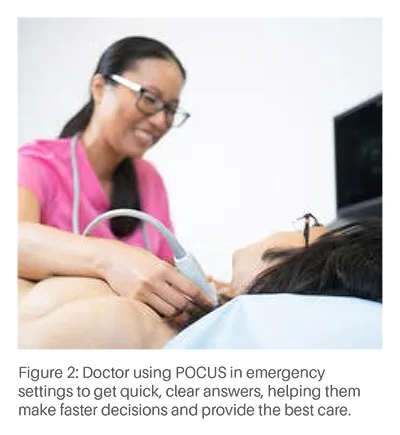
For paramedics, POCUS has become an invaluable tool in assessing trauma, cardiac, and respiratory conditions. In trauma cases, it helps identify internal bleeding, fractures, and organ damage. When dealing with cardiac emergencies, paramedics can quickly check for heart failure, pericardial effusion, or even cardiac arrest. In respiratory distress situations, they can assess conditions like pneumothorax, pulmonary edema, and pneumonia. Additionally, paramedics can use POCUS to detect gallstones, free fluid indicating internal bleeding, or obstructions in the abdomen. Even vascular conditions such as deep vein thrombosis can be identified on-site, allowing for quicker and more efficient patient management. By incorporating ultrasound into prehospital care, paramedics can make better decisions about transport and prioritize critical patients, ensuring they receive appropriate treatment as soon as possible.
Physicians in emergency settings also benefit immensely from POCUS. It allows them to quickly diagnose and manage cardiac emergencies, from heart failure to severe arrhythmias. Respiratory distress cases can be assessed in minutes, helping doctors determine if a patient is suffering from pneumonia, pulmonary edema, or pleural effusion. In abdominal emergencies, ultrasound helps detect conditions like gallstones, appendicitis, or bowel obstructions without the need for time-consuming imaging. Vascular health assessments become more precise, as physicians can check a patient’s fluid status and identify conditions like deep vein thrombosis. Even in obstetric and gynecologic emergencies, POCUS plays a crucial role in identifying ectopic pregnancies, fetal distress, or ovarian cysts. With the ability to diagnose these conditions at the bedside, doctors can act faster, reducing hospital stays and streamlining patient care.
Why Some Doctors Are Hesitant About POCUS
Despite its many benefits, not all physicians are in favor of POCUS. Some argue that its use outside of radiology or cardiology lacks sufficient oversight and may lead to misdiagnosis if not performed correctly. Unlike traditional ultrasound conducted by specialists, POCUS is often used by non-radiologists with varying levels of training. This raises concerns about interpretation errors and potential overreliance on ultrasound without corroborating clinical findings. Additionally, there is resistance from some physicians who are accustomed to traditional diagnostic pathways and may be hesitant to adopt new technology without extensive validation and guidelines.
Concerns about the use of POCUS outside specialized departments are documented. Some physicians worry that without proper training, POCUS could lead to misdiagnosis. A study highlighted that the use of POCUS without adequate training could result in overconfidence and potential diagnostic errors.
One major point of misunderstanding is the difference between POCUS and traditional ultrasound. Traditional ultrasound is typically performed in a controlled setting by trained sonographers or radiologists using high-end machines designed for detailed, in-depth imaging. The images are reviewed and interpreted in a systematic manner, often with additional imaging or laboratory tests to confirm findings. POCUS, on the other hand, is a bedside tool meant for rapid, real-time assessment. It is used primarily to answer specific clinical questions, such as "Is there free fluid in the abdomen?" or "Is there cardiac activity in a patient in cardiac arrest?" rather than providing a comprehensive diagnostic evaluation. This targeted approach can be extremely effective in emergency settings but requires appropriate training to ensure accurate interpretation. Some physicians worry that without proper training, the risk of overconfidence in POCUS findings could lead to missed diagnoses or incorrect treatment decisions.
Another challenge is the cost of training and equipment. While portable ultrasound devices are becoming more affordable, the initial investment can still be a barrier for smaller hospitals and emergency medical services. Ensuring proper training is also critical; without standardized education and certification, the effectiveness of POCUS can be compromised.
How POCUS is Saving Money and Improving Healthcare for Everyone
Beyond the clinical advantages, POCUS brings significant economic and societal benefits. By enabling quicker diagnoses, it reduces the need for expensive imaging tests like CT scans and MRIs, lowering overall healthcare costs. Patients also benefit from shorter hospital stays since early detection leads to faster treatment and recovery. This not only improves individual health outcomes but also helps free up hospital resources, making the healthcare system more efficient. Emergency response times are optimized as well, with paramedics able to determine the severity of a patient’s condition and provide immediate care. As a result, unnecessary hospital visits are reduced, alleviating the strain on overcrowded emergency departments. By integrating POCUS into routine practice, healthcare systems can enhance efficiency while improving patient outcomes.
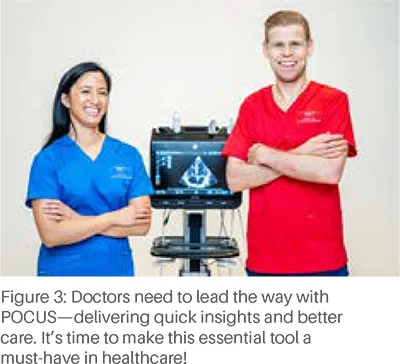
Spreading the Word: How to Make POCUS a Must-Have in Healthcare
To fully unlock the potential of POCUS, increasing awareness and training among healthcare providers is essential. Medical schools and paramedic programs should integrate POCUS training into their curricula, ensuring that future professionals are well-versed in its applications. Ongoing workshops and continuing medical education courses can help practicing doctors and paramedics stay updated on the latest ultrasound techniques. Hospitals and emergency medical services should invest in portable ultrasound devices and provide training programs to encourage widespread use. Additionally, public support and policy changes can play a significant role in promoting POCUS adoption, ensuring that it becomes a standard tool in emergency and prehospital care.
What’s Next for This Game-Changing Technology?
As technology continues to evolve, the future of POCUS looks promising. Advances in artificial intelligence and machine learning are enhancing ultrasound interpretation, reducing human error, and making the technology more accessible to non-specialists. Additionally, wireless and handheld ultrasound devices are improving mobility, allowing healthcare providers to use POCUS in even the most remote locations. The integration of telemedicine with POCUS is also a growing trend, enabling real-time expert guidance for paramedics and rural healthcare workers.
As POCUS becomes more widely accepted, regulatory bodies may implement standardized training and certification programs to ensure quality and consistency in its use. More research and clinical trials will further validate its applications and effectiveness across different medical fields, solidifying its role in modern healthcare.
Conclusion
POCUS is transforming emergency and prehospital care by enabling faster, more accurate diagnoses and immediate patient management. Despite some challenges and resistance, its benefits far outweigh the drawbacks, and with proper training and awareness, its adoption will continue to grow. As more paramedics, emergency physicians, and healthcare providers recognize its value, patient outcomes will continue to improve, and healthcare systems will become more efficient. With increased education, investment, and integration, POCUS will remain a vital tool in emergency preparedness, ensuring better healthcare delivery in critical situations.
References
1. Choi W, Cho Y et al. Role of point-of-care ultrasound in critical care and emergency medicine: update and future perspective. Clin Exp Emerg Med 2023 Dec 29;10(4):363–381. doi: 10.15441/ceem.23.101
2. Lentz B, Fong T et al. POCUS has demonstrated cost-effectiveness in emergency care. A systematic review indicated that using POCUS in trauma evaluations consistently resulted in cost savings. The Ultrasound Journal volume 13, Article number: 16 (2021)
3. Schaik G, Schaik K et al. Point-of-Care Ultrasonography (POCUS) in a Community Emergency Department: An Analysis of Decision Making and Cost Savings Associated With POCUS. J Ultrasound Med 2019 Aug;38(8):2133-2140. doi: 10.1002/jum.14910. Epub 2018 Dec 28.