
The Growing Burden of Cardiovascular Disease in Liberia
Cardiovascular disease (CVD) is a rapidly growing health challenge across Sub-Saharan Africa, yet most healthcare systems in the region remain underprepared for the increasing prevalence of ischemic heart disease. Liberia is no exception. Emerging from years of civil conflict and the Ebola epidemic, the Liberian healthcare system has prioritised rebuilding primary care and infectious disease programs. However, non-communicable diseases such as hypertension, diabetes, and cardiovascular events now represent a significant—and growing—burden.
In acute myocardial infarction (AMI), early diagnosis and rapid treatment are critical. International guidelines emphasise the “golden hour,” in which reperfusion therapy offers the greatest benefit. Yet in Liberia, the absence of routine ECG availability and limited cardiology expertise outside the capital has meant delayed diagnosis, late referrals, and preventable mortality. The challenge lies not only in the shortage of cardiologists but also in geography: Liberia’s 15 counties include remote rural regions with poor transport and limited emergency services. This context makes a strong case for digital innovation and telemedicine-enabled cardiac care.
Why a Nationwide ECG Telemedicine Network?
Electrocardiography (ECG) is the cornerstone of cardiac diagnostics. An inexpensive, non-invasive test, the ECG can rapidly identify myocardial infarction, arrhythmias, and conduction disturbances. In high-resource settings, ECGs are ubiquitous, with near-instant access to cardiologists. In Liberia, however, the reality is starkly different: many county hospitals and clinics lack even a single functioning ECG machine, and few health workers are trained to interpret results.
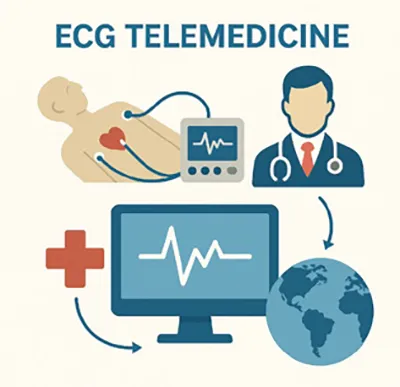
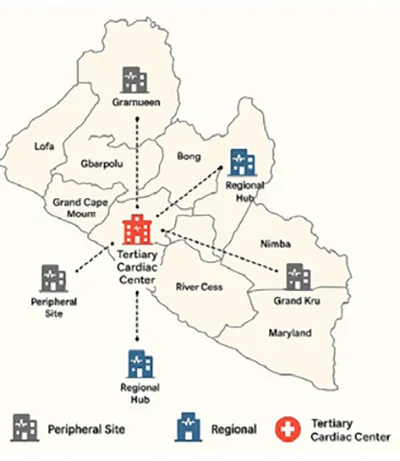
A nationwide telemedicine ECG network aims to close this gap by connecting every county hospital in Liberia to centralised interpretation hubs staffed with trained personnel and supported by a tertiary referral center. This hub-and-spoke model ensures that even the most remote clinic can capture ECGs and transmit them digitally for expert review. The benefits are threefold: patients receive rapid diagnosis of acute coronary syndromes; county hospitals are guided to initiate thrombolysis before onward referral; and a centralised database allows long-term monitoring of chronic cardiac conditions for both clinical care and research.
Designing the System: Hub-and-Spoke Model
The proposed infrastructure links all 15 counties into a three-tiered system. At the periphery, county hospitals and selected district health centers are equipped with portable digital ECG machines. These devices capture 12-lead ECGs, which can be uploaded securely using mobile or satellite internet. At the next level, designated regional hospitals serve as hubs, staffed with trained ECG technicians and general physicians who provide first-line reviews and coordinate patient transfers. Finally, the tertiary referral facility, ideally the John F. Kennedy Medical Center in Monrovia, acts as the national cardiac center. Staffed by cardiologists and emergency physicians, it is the final point of interpretation, treatment decision-making, and triage.
Data flows through a cloud-based telemedicine platform designed with redundancy and real-time feedback. Importantly, the system functions on an offline-first principle, automatically synchronising data once internet access becomes available in low-connectivity areas.
Remote Monitoring and Emergency Response Workflow
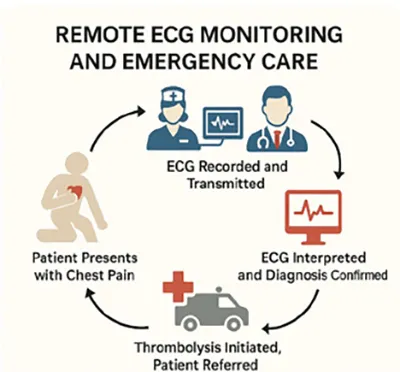
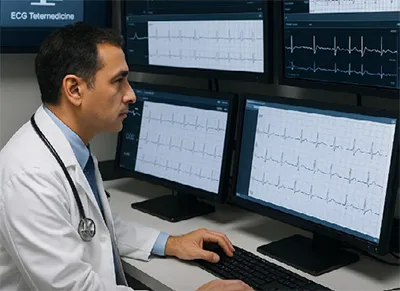
Consider a patient presenting to a county hospital with chest pain. The attending nurse records a 12-lead ECG within minutes, and the digital system uploads the tracing to the regional hub. A trained technician identifies a probable ST-elevation myocardial infarction (STEMI) and sends an alert to the tertiary center, where a cardiologist confirms the diagnosis. If the patient is eligible, thrombolysis can be initiated immediately at the county hospital—a dramatic shift from the current system in which patients often wait hours or days for transfer. Once stabilised, the patient is referred onward to the tertiary hospital for advanced management.
This process transforms outcomes. A patient in remote Lofa County can access the same rapid diagnosis and life-saving treatment as one presenting directly to Monrovia. “Telemedicine transforms access to care, enabling rural clinics to deliver life-saving thrombolysis within the golden hour.”
Capacity Building: Training Healthcare Workers
Technology alone cannot achieve success; human capacity building is essential. A nationwide ECG program requires training for nurses, physician assistants, and general doctors. Modules include ECG acquisition and troubleshooting, recognition of acute coronary syndromes, protocol-driven administration of thrombolytics, and post-thrombolysis monitoring with transfer procedures. Training combines in-person workshops with digital platforms and is structured in a “train-the-trainer” model. This ensures sustainability as local staff gradually take responsibility for training new cohorts, reducing dependence on external experts.
Digital Infrastructure and Data Security
The telemedicine platform operates on cloud-based servers with end-to-end encryption to ensure data privacy. Given the sensitive nature of health information, data sovereignty is prioritised, with hosting designed to comply with Liberian health regulations. The platform also creates a longitudinal patient registry. Every ECG and clinical note is stored, enabling long-term follow-up of patients with arrhythmias, heart failure, or recurrent ischemia. Over time, this registry will evolve into a valuable resource for epidemiological research and health policy planning.
Challenges and Solutions
Several obstacles threaten the success of this initiative. Connectivity remains a challenge, as many rural areas have poor mobile coverage, but offline-first technology and satellite backups mitigate the problem. Funding is another barrier, since the initial costs of equipment, training, and digital infrastructure are significant. Sustainability will rely on public-private partnerships and donor engagement. Workforce retention also presents difficulties, as training only delivers value if healthcare workers remain in their posts; therefore, incentive structures and career progression opportunities are necessary. Finally, access to medications such as thrombolytics must be guaranteed through stronger supply chains.
Despite these hurdles, pilot studies in neighboring countries show that tele-ECG networks are both feasible and impactful. “A nationwide ECG network can bridge geography and inequity, making early diagnosis of heart attacks possible in every Liberian county.”
Future Directions: Toward Catheterisation Laboratories
While thrombolysis is the current standard in resource-limited settings, primary percutaneous coronary intervention (PCI) remains the gold standard. Establishing a tele-ECG network is therefore not the final step but a foundation for future expansion. The national registry of ECG-diagnosed STEMIs will provide data on disease burden and justify investments in catheterisation laboratories. Once PCI becomes available, the telemedicine system can seamlessly support triage to cath labs, reducing unnecessary delays.
Beyond this, the infrastructure can evolve to support wearable ECG monitors for high-risk patients, artificial intelligence-assisted ECG interpretation, and even remote echocardiography and tele-ultrasound for more comprehensive cardiac imaging.
Global Relevance: Lessons for Other Low-Resource Countries
Liberia’s journey reflects a broader challenge across Sub-Saharan Africa and other low-resource regions, where countries face the double burden of infectious disease and rising cardiovascular mortality.
Telemedicine ECG networks provide a scalable and cost-effective solution adaptable to diverse healthcare settings.
Key lessons emerge: starting small with pilot counties before scaling nationwide; prioritising human capacity building alongside technology; fostering partnerships across government, NGOs, telecom providers, and academic institutions; and embedding monitoring and evaluation systems to measure impact continuously. Liberia’s experience could ultimately serve as a model for a West African Cardiac Telemedicine Alliance.
“This initiative lays the foundation for future catheterisation laboratories and advanced cardiac interventions in Liberia.”
Conclusion
The creation of a nationwide ECG telemedicine network in Liberia represents a transformative step toward equitable cardiac care. By linking rural clinics to cardiology expertise, enabling early thrombolysis, and establishing a robust digital backbone, Liberia can address the growing challenge of cardiovascular disease despite limited resources.
This initiative demonstrates how innovation, collaboration, and digital health can leapfrog infrastructural barriers. While challenges remain, the vision is clear: a future where no Liberian patient dies needlessly of a heart attack simply because they lived too far from a cardiologist.
Moreover, this model is not unique to Liberia alone. Its hub-and-spoke telemedicine framework can be readily adapted across West Africa and other African nations facing similar geographic, infrastructural, and workforce constraints. By leveraging regional partnerships and digital health platforms, the network approach offers a scalable blueprint for strengthening cardiovascular care systems continent-wide.
Global Outlook
The Liberian experience also carries lessons for the wider region. Cardiovascular disease is a rising public health challenge across West Africa and the broader African continent, where healthcare systems often face similar constraints in geography, workforce, and infrastructure.
The hub-and-spoke telemedicine framework demonstrated in Liberia provides a replicable and scalable model. By equipping peripheral hospitals with ECG capability, establishing regional hubs, and anchoring them to national or regional cardiac centers, other countries can rapidly build capacity for acute cardiac care. Importantly, such networks not only improve immediate outcomes but also create long-term data systems to guide investment in advanced services such as catheterisation laboratories and interventional cardiology.
If supported by regional cooperation, public–private partnerships, and sustained training, this model can evolve into a West African cardiac telemedicine alliance, extending lifesaving innovations across borders and paving the way for a stronger, continent-wide response to cardiovascular disease.