
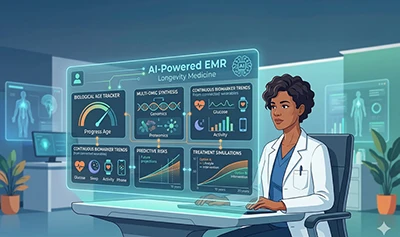
1. How can AI effectively integrate and reconcile heterogeneous data sources such as EMRs, medical imaging, genomics, and wearable-derived continuous signals to create clinically meaningful patient narratives rather than fragmented data silos?
The hard part is not "getting the data in." The hard part is reconciliation: different formats, different sampling rates, different error modes, and different clinical meanings.
AI can help by doing four jobs that humans do poorly at scale. First, normalisation: mapping terms, units, and ontologies so the system knows whether two fields are truly comparable. Second, identity and time alignment: ensuring the right data belongs to the right person and is anchored to the correct time window, which is essential for causal interpretation. Third, contextual summarisation: converting raw streams into clinically legible constructs like baseline, trend, variability, change point, and recovery after stressors. Fourth, narrative generation with traceability: producing a concise "what changed, when, why it might matter, and what to do next" summary, while allowing the clinician to drill down to the underlying evidence.
When this is done well, the output is not a dashboard with twenty graphs. It is a patient narrative: "Over six months, nocturnal blood pressure is rising, sleep regularity is fragmenting, and glucose variability is worsening, which together suggest declining metabolic flexibility. Next step: confirm with home BP protocol, short CGM block, and targeted lifestyle or pharmacologic plan, and then remeasure in four to eight weeks."
2. In practical clinical workflows, where are you already seeing AI deliver measurable improvements in early risk detection, disease progression monitoring, or preventive intervention planning, and what differentiates these use cases from experimental pilots?
The most convincing examples share one trait: they are tied to a defined clinical pathway, not a curiosity dashboard.
Wearable-enabled arrhythmia detection is a good illustration. In the Apple Heart Study, irregular pulse notifications were rare, and among those notified who wore an ECG patch, a meaningful fraction had atrial fibrillation documented. That matters because it links signal detection to a real next step: confirmatory monitoring and then guideline-based anticoagulation decisions when appropriate.
More broadly, in day-to-day systems, AI is increasingly "quietly useful" in three workflow-friendly ways: early risk flagging that triggers confirmatory testing rather than immediate labeling, longitudinal monitoring that spots trend breaks rather than single abnormal results, and preventive planning that prioritises the smallest set of interventions most likely to bend a trajectory.
What differentiates production use from pilots is boring, and that is the point: clear ownership, defined escalation thresholds, monitoring of real-world performance, and integration into the clinician's normal workflow rather than a separate interface.
3. As AI systems increasingly translate longitudinal data into predictive trajectories, how do you see the role of clinician judgment evolving, and where should human oversight remain non-negotiable?
As AI translates longitudinal data into predictive trajectories, clinician judgment shifts from being primarily a detector of disease to being an interpreter of direction and a designer of safe action plans.
AI will get better at pattern recognition across time and modalities. What it will not own is the full clinical context: competing goals, patient values, comorbidities, medication tolerance, psychosocial constraints, and the ethical tradeoffs of acting on risk rather than disease.
Human oversight should remain non-negotiable in at least four areas: diagnosis and irreversible decisions such as starting lifelong therapies, invasive testing, or procedures; tradeoffs under uncertainty where harms and benefits are close; equity and bias checks to ensure performance holds across subgroups and settings; and accountability and informed consent, because the clinician remains responsible for what is done to the patient.
In other words, AI can draft the map. Clinicians still choose the route, explain the risks, and stay accountable for the outcome.
4. How can AI-powered EMRs support truly personalised interventions in longevity medicine while avoiding overfitting to individual data patterns or reinforcing existing clinical biases?
Personalisation is essential in longevity medicine, but it has a dark side: overfitting to noisy individual patterns and hardening existing clinical inequities.
The safest approach is to combine population-level evidence with individual response learning. Start with guideline-grounded interventions that have a broad benefit. Use longitudinal data to identify who is deviating from expected response, and adjust intelligently. Treat personalisation as a controlled learning loop: small change, measurable outcome, re-evaluate.
To avoid overfitting, models should incorporate uncertainty estimates and minimum evidence thresholds before declaring "meaningful change." To avoid bias, systems need explicit fairness evaluation and ongoing monitoring because device ownership, sensor accuracy, and data completeness are not evenly distributed across patients.
A personalised plan is not "the algorithm says so." It is a transparent hypothesis with confirmations, constraints, and follow-up measurements.
5. From a clinical adoption standpoint, what workflow integrations are essential for AI tools to be perceived as decision-support assets rather than administrative or cognitive burdens?
Clinicians adopt tools that save time, reduce cognitive load, and improve care clarity.
Essential workflow elements include native EMR integration with no separate logins and minimal extra clicks. Timing and placement matter: insights should surface in the chart review and decision moments, not be buried in a tab. Summaries should be action-oriented, answering what changed, why it matters, the confidence level, and the recommended next step. Team-based routing is also critical because not everything needs the physician. Many signals can be triaged by nursing, health coaches, or care coordinators with defined protocols. And documentation assistance that converts longitudinal interpretation into clean clinical notes and patient instructions can dramatically reduce burden.
If AI adds a new inbox, it will fail. If it shortens the distance from data to decision, it will scale.
6. How do you assess the readiness of current EMR platforms to support advanced AI capabilities, particularly for longitudinal analysis and continuous data ingestion, without compromising data integrity or usability?
Most EMRs were built to document encounters, bill for episodes, and store discrete fields. Longitudinal physiology was not the core design assumption.
So readiness is uneven. The limiting factors are typically time-series data handling (storing and querying high-frequency streams in a usable way), data provenance and integrity (knowing what device produced the signal, under what conditions, and how it was processed), and interoperability and governance (consistent schemas and reliable pipelines, or else the model learns artefacts).
The best near-term architecture is often a clean separation: the EMR remains the system of record, while a longitudinal data layer ingests wearables, home monitoring, and multi-omics, then returns clinically curated summaries back into the workflow. If you try to shove continuous physiology into a legacy encounter framework without redesign, you get clutter, confusion, and clinician backlash.
7. In the context of early detection and preventive care, how should AI systems balance sensitivity and specificity to ensure timely intervention without driving unnecessary testing or patient anxiety?
In preventive care, the harm profile is different. A false negative can miss a window of opportunity. A false positive can cascade into unnecessary testing, cost, and anxiety.
The right balance depends on three variables: disease severity, availability of a low-harm confirmatory test, and the actionability of early intervention.
Practically, AI systems should use tiered outputs. A low-level "watchful" risk signal might trigger repeat measurement or lifestyle reinforcement. A higher threshold would trigger confirmatory diagnostics. The highest threshold triggers clinical escalation. The goal is not a perfect prediction. The goal is a safe and efficient pathway: detect early, confirm appropriately, and intervene proportionally.
The communication layer matters too: patients tolerate uncertainty better when the message is framed as "this is a screening signal, not a diagnosis, and here is the next step."
8. How can clinicians critically differentiate between AI tools that are clinically validated and those driven primarily by marketing narratives or technology hype, especially in the rapidly evolving longevity medicine space?
A useful question is: "Show me the pathway and the receipts."
Clinicians should look for peer-reviewed validation with clear endpoints and comparison to standard care, evidence of generalizability across sites and populations, transparent reporting of calibration, subgroup performance, and failure modes, real-world metrics post-deployment, including alert burden and downstream testing impact, and a clear regulatory posture when appropriate, though not as a substitute for clinical evidence.
Marketing narratives emphasise novelty and AUC. Clinically serious tools emphasise limitations, workflows, and measured outcomes.
If a vendor cannot clearly answer "what happens next when the model fires," it is not decision support. It is a liability generator.
9. What skills or literacy do clinicians need to develop to effectively interpret AI-generated insights within EMRs, and how should medical training evolve to support this shift?
Clinicians do not need to become data scientists. They do need literacy.
Core skills include interpreting performance metrics such as sensitivity, specificity, PPV, and calibration. Clinicians need to understand dataset shift and why models fail when workflows change. They must recognise biased sources, including measurement bias, selection bias, missingness, and subgroup performance gaps. They should know how to ask the right operational questions about alert burden, ownership, escalation protocols, and monitoring plans. And they need to communicate probabilistic outputs to patients in a way that preserves trust.
Medical education should treat AI the way it treats diagnostics: not as magic, but as a tool with indications, contraindications, and known error modes. Training should also become more longitudinal in mindset, because the clinician of the next decade will increasingly manage trends, not isolated values.
10. Looking ahead, how do you envision AI-powered EMR and data management systems reshaping preventive care, patient engagement, and long-term outcome measurement over the next decade from a clinician-led perspective?
Looking ahead, I expect the EMR to evolve from a static record into a longitudinal operating system for preventive care.
Three shifts are likely. First, preventive care becomes measurable: instead of hoping lifestyle changes worked, clinicians will see trend movement in sleep regularity, blood pressure patterns, glucose dynamics, and functional markers, and adjust earlier. Second, patient engagement becomes more specific: not generic advice, but "here are your two highest-leverage levers and here is how we will measure success." Third, outcome measurement becomes long-term and real-world: health systems will track time to risk factor control, sustained behavior change, downstream utilisation, and function over years, not just visit-based proxies.
The big caution is trust. Trust is earned through validation, governance, and humane workflow design. If we overload clinicians or frighten patients with noisy predictions, adoption will stall. If we use AI to reduce friction, focus attention, and standardise high-quality preventive pathways, trajectory-based care will become the expectation rather than the exception.
Read the full article — it's free
Register with EuropeanHHM to unlock expert insights, research articles and in-depth industry analysis.