
Book Description:
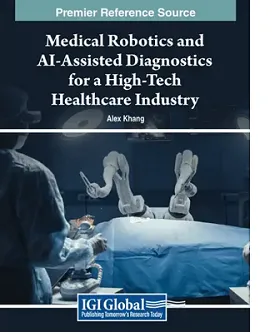 Despite advancements in ultra-high field strength imaging and AI for precise medical microstructure analysis, challenges persist, including lengthy scans, motion artifacts, and tissue-specific image quality limitations. "Medical Robotics and AI-Assisted Diagnostics for a High-Tech Healthcare Industry" addresses these issues by summarizing emerging techniques, outlining clinical applications, and proposing future research directions. It explores innovations like human-like robotics, medical IoT, affordable CT and portable MRI, alongside diagnostic breakthroughs such as zero echo time (ZTE) and compressed sensing volume interpolation breath-holding test sequences (CS-VIBE).
This book provides a current overview of medical imaging and diagnostics, then maps a future where medical robotics and AI are seamlessly integrated into high-tech healthcare. Recognizing AI's growing impact, it emphasizes collaboration, research, and unified strategies to overcome challenges and leverage opportunities within this advanced medical landscape.
Ideal for medical and biotech analysts, healthcare scientists, scholars, researchers, academics, professionals, engineers, and students globally, this book consolidates expert insights on machine learning, deep learning, computer vision, AI-integrated applications, IoT, human-like robotics, healthcare data analytics, and biotechnology within an AI-driven healthcare era.
1. The title juxtaposes “Medical Robotics” and “AI-Assisted Diagnostics.” How do these two domains complement each other in redefining high-tech healthcare delivery, and why did you feel it was essential to position them together in the title?
Medical robotics offers the physical means for precision and automation in tasks like surgery and drug dispensing. However, its true potential is realized when guided by the superior intelligence of AI. AI, covered extensively in this book, provides cognitive intelligence, processing vast datasets from imaging, biosensors, and patient records for accurate, rapid diagnostics. Their convergence AI guiding robotic precision in surgery, automating lab tasks, or personalizing rehabilitation redefines healthcare. This intelligent automation augments human capabilities, leading to unprecedented efficiency, safety, and personalized patient care.
2. The phrase “High-Tech Healthcare Industry” is broad and ambitious. In your view, what specific technologies or systemic changes qualify healthcare as truly ‘high-tech’ in the current decade?
True high-tech healthcare requires systemic transformation beyond digitization. It integrates Pervasive AI, including Gen AI for drug discovery and personalized treatment, IoMT for real-time monitoring, and Digital Twins for predictive modeling. Advanced connectivity (6G) supports remote procedures, Blockchain secures patient data, and Big Data and Cloud Computing generate actionable insights. AR/VR enhance clinical practice. These technologies advance healthcare toward a P4 model preventive, personalized, participatory, and predictive empowering patients and providers with smarter, data-driven, and human-centric care.
3. Why was it important to emphasize “AI-Assisted Diagnostics” rather than just “AI in Diagnostics”? Does this nuance imply a human-machine collaboration rather than full autonomy?
The term AI-Assisted Diagnostics highlights our commitment to human-in-the-loop collaboration, a foundational element of responsible AI in healthcare. While AI delivers exceptional speed and precision in data analysis, final diagnostic decisions must rest with qualified clinicians. This approach ensures ethical accountability, preserves clinical nuance, fosters trust, and compensates for AI’s limitations. Emphasizing human-machine collaboration reflects the human-centered ethos of Industry 5.0, reaffirming that AI is a powerful augmentative tool, not a replacement for expert medical judgment.
4. How does the integration of “Medical Robotics” in clinical settings go beyond surgical applications, as suggested by the scope implied in your title?
As editor of the book, I emphasize that medical robotics go far beyond surgery. Chapters like 9 and 27 explore robotics in labs, rehabilitation, drug dispensing, telepresence, sanitation, and patient support. Robots automate testing, enable remote care, manage medication, and assist mobility. These innovations aligned with Industry 5.0 principles enhance efficiency, safety, and personalization. Medical robotics now permeate clinical operations, transforming healthcare delivery across every touchpoint with intelligent, human-centered automation.
5. In the context of your book, how does the word "Industry" in “High-Tech Healthcare Industry” reshape our traditional understanding of healthcare as a purely service-oriented field?
The inclusion of "Industry" in "High-Tech Healthcare Industry" was a deliberate editorial choice to fundamentally reshape the traditional, often narrow, purely service-oriented view and innovation of healthcare.
- Data as a Commodity/Asset: Anonymized health data fuels research, personalization, analytics, and security.
- Economic Drivers and Market Forces: Investment, competition, and scalability push healthcare’s industrial transformation globally.
- Cross-Sector Integration: Healthcare blends with tech, pharma, insurance, and consumer sectors seamlessly.
- Standardization and Scalability: Unified platforms ensure interoperable, efficient, and large-scale healthcare solutions.
6. To what extent is the transformation into a “High-Tech Healthcare Industry” dependent on cross-sector partnerships, and how is this trend reflected throughout your book?
This dependency is a central thesis we aimed to convey throughout the book:
- Technology Providers & Healthcare Systems: Developers and clinicians co-create smart systems for advanced diagnostics.
- Academia & Industry: Academic breakthroughs scale through strategic commercial healthcare partnerships.
- Pharmaceutical/Biotech & Tech: Biotech and AI collaborate for sensors, analytics, and smart pills.
- Regulators & Innovators: Ethical deployment needs coordination between developers and regulatory bodies.
- Startups & Established Players: Startups innovate, giants scale solutions for healthcare transformation globally.
7. Can you share your reasoning behind choosing the phrase "AI-Assisted Diagnostics" over more commonly used terms like “AI-Driven” or “AI-Enabled”? What conceptual boundaries does this set for your readers?
The deliberate editorial choice of the phrase was absolutely central to the book's overarching human-centered philosophy, which aligns perfectly with the principles of Industry 5.0. This specific phrasing sets crucial conceptual boundaries for our readers:
- "AI-Driven" Implies Autonomy: Suggests autonomous decision-making; risks accountability and lacks human intuition for complex diagnostics.
- "AI-Enabled" is Too Passive: Implies passive functionality; fails to convey AI’s active, collaborative role in healthcare decision-making.
- "AI-Assisted" Emphasizes Augmentation and Collaboration: Highlights AI-human synergy; empowers clinicians with rapid analysis, detection, and context-rich decision
8. “Medical Robotics” can encompass a wide array of devices. In framing the title, were you primarily thinking of autonomous robotic systems, or did the term include wearable and assistive technologies as well?
When framing "Medical Robotics" in the title, we were absolutely thinking of a broad and comprehensive spectrum of robotic and automated systems, extending significantly beyond just autonomous surgical robots of:
- Autonomous Robotic Systems: Robots perform surgeries, logistics, disinfection, and automate complex laboratory processes efficiently.
- Wearable and Assistive Technologies: Devices aid mobility, monitor health, deliver treatment, and enhance patient recovery.
- Cobots: Cobots support humans in precision tasks through safe, adaptive, shared workflows.
- Micro- and Nano-Robotics: Tiny robots enable targeted drug delivery and ultra-minimally invasive diagnostics innovations.
9. How does your book challenge or reinforce existing notions of AI and robotics as disruptive technologies within the healthcare domain, as suggested by the forward-looking title?
Our book, primarily reinforces the notion of AI and robotics as profoundly disruptive technologies within the healthcare domain.
- Reinforcement of Disruption: The book’s breadth reveals radical shifts in care delivery, management, workflows, roles, and business models.
- Challenging Negative Perceptions: Advocates human-centered Industry 5.0, showing disruption empowers clinicians not replaces them with AI-augmented decision-making efficiency.
- Focus on Ethical and Practical Challenges: Explores ethical deployment, cybersecurity, and quantum challenges, guiding responsible adoption of disruptive healthcare technologies and innovation.
10. The title signals both current applications and future visions. How do you balance present-day practicality with future-oriented innovation throughout the chapters?
Balancing present-day practicality with future-oriented innovation was a core design principle that guided the entire structure and content selection for the book.
- Foundational Principles and Current Applications: Chapters 1, 4, 9, 15, 18, 23, 27 explore real-world AI applications.
- Progressing to Emerging Technologies: Chapters 11, 12, 13 examine 6G, AR/VR, quantum innovations shaping healthcare’s future.
- Challenges and Ethics of Future Technologies: Chapter 35 tackles ethical dilemmas and deployment risks of advanced healthcare technologies.
- Bridging the Gap and Evolutionary Paths: Chapter 30 maps transition from current systems to future intelligent digital ecosystems.
11. In selecting such a forward-facing and integrative title, were you targeting primarily academic audiences, or were you also hoping to influence healthcare policymakers and technology developers?
While the book's depth, rigorous academic content, and comprehensive nature certainly cater to academic audiences including researchers, university faculty, and graduate students across disciplines such as computer science, data science, biomedical engineering, and health informatics my ambition as editor was significantly broader.
- For Policymakers: Chapters 1, 29, 30, 35 inform digital health strategy, regulatory planning, ethical governance, and funding priorities.
- For Technology Developers: Explores IoT, AI, Blockchain applications; guides innovation through diagnostics, monitoring, automation, and integration strategies.
- For Healthcare Practitioners and Administrators: Equips clinicians and administrators to lead digital transformation, reshape workflows, and understand AI’s clinical impact.
12. With “Medical Robotics and AI-Assisted Diagnostics” front and center, what core message or paradigm shift do you hope readers will walk away with, particularly in terms of preparing for a next-generation healthcare ecosystem?
Next-gen healthcare means intelligent augmentation and automation, shifting care from reactive to proactive and generalized to hyper-personalized precision.
- From Manual to Automated Precision: Automation boosts precision, reduces errors, improves surgical and laboratory efficiency.
- From Intuition to Data-Driven Insight: AI enables predictive diagnostics through vast, integrated, complex data analysis.
- Human-Technology Symbiosis: AI augments clinicians, supporting empathy, judgment, and patient-centered care.
- Proactive and Personalized Care: AI enables early detection and tailored, real-time treatment plans.
- Enhanced Accessibility and Efficiency: Robotics and AI expand care reach and reduce healthcare costs.