
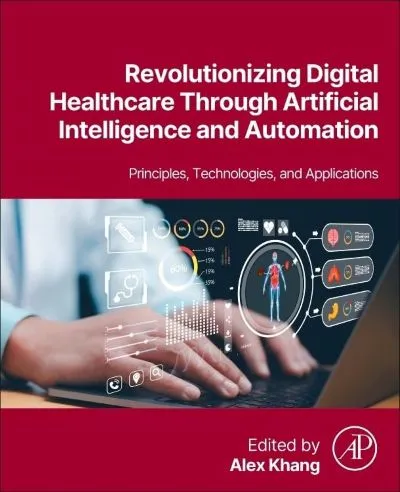
1. Your book’s title speaks of “revolutionizing” digital healthcare through AI and automation. In what specific ways do you believe current digital healthcare systems are undergoing this revolution?
Digital healthcare is being revolutionised by AI and automation through faster, more accurate diagnostics, predictive analytics, and personalised treatments. Automation streamlines administrative tasks, while virtual assistants and remote monitoring enhance patient engagement and access. AI-driven tools support clinical decisions, optimise drug development, and enable robotic surgeries. Together, these technologies are transforming care delivery from reactive to proactive, improving outcomes, efficiency, and accessibility across the healthcare system.
2. The subtitle mentions “Principles, Technologies, and Applications.” Could you elaborate on the foundational principles that guided your exploration of AI in digital healthcare?
The foundational principles of AI in digital healthcare prioritise patient-centered care, ethical deployment, and interdisciplinary collaboration. AI technologies aim to enhance healthcare delivery with empathy, focusing on patient outcomes. Ethical considerations demand transparency, fairness, privacy, and accountability. Successful implementation hinges on collaboration between healthcare professionals, data scientists, and engineers. High-quality, representative data is crucial for reliable AI. Systems must also be scalable, interoperable, and compliant with healthcare standards. Clinical safety and validation are paramount, ensuring rigorous testing for trustworthy, effective, and sustainable AI integration into healthcare.
3. Among the many technologies you covered - AI-driven imaging, IoT, robotics, and VR - which do you believe is currently the most disruptive in healthcare, and why?
Among transformative technologies in digital healthcare, AI-driven imaging, IoT, robotics, and virtual reality, AI-driven imaging stands out as the most disruptive due to its clinical impact, scalability, and real-world integration. It enhances diagnostic accuracy for conditions like cancer and stroke, processes vast image data efficiently, and supports early intervention. Already deployed globally, it integrates seamlessly with radiology workflows and expands access in underserved areas. By reducing delays, unnecessary tests, and readmissions it improves resource efficiency. While other technologies show promise, AI imaging’s maturity and immediate utility make it the most impactful innovation in healthcare today.
4. You discuss real-world implementations of AI in modern medicine. Can you share a case study or example from the book that best illustrates the tangible impact of AI in patient care?
In our book, Chapter 18 presents a compelling case study on an advanced AI system for brain tumor detection and classification using deep learning and MRI. This autonomous system, designed to support clinical decision-making, begins with a precise, computationally efficient ResNet50-based CNN for classifying MRI scans and detecting tumors. Subsequently, a ResUNet-based segmentation model localises tumour boundaries with high accuracy, using a focal Tversky loss function to address class imbalances. Achieving 96% training accuracy, this AI-driven approach significantly speeds up diagnosis and enhances precision, enabling more informed treatment decisions, improving patient outcomes, and augmenting clinical expertise in modern healthcare.
5. Security and data privacy are critical in healthcare. How does your book address the challenges and solutions around safeguarding digital health records in AI-powered ecosystems?
Our book highlights key risks in AI-powered, interconnected healthcare environments, including data breaches, outdated systems, and weak authentication. To mitigate these threats, it recommends secure key management, robust authentication protocols, regular system updates, and device hardening. It also promotes global best practices and urges developing countries to adopt secure smart lab systems. The central message is clear: protecting digital health records is vital for building trust and ensuring safe, reliable care in the age of AI and the Internet of Medical Laboratory Things.
6. How do automation and artificial intelligence complement each other in the context of digital healthcare? Are there risks when automation outpaces human oversight?
AI analyses data, recognises patterns, and provides insights (e.g., predicting sepsis or billing issues). Automation then executes routine tasks based on these insights (e.g., alerting staff, initiating tests, rescheduling appointments). This synergy enhances efficiency, accuracy, and scalability, reducing manual workload and enabling faster, more personalised care.
Yes, significant risks arise when healthcare automation outpaces human oversight. These include loss of clinical judgment, amplified biases from flawed data, widespread harm from system errors or cyberattacks, and accountability issues. Mitigation requires human-in-the-loop oversight, transparent AI, regular audits, and strong ethical safeguards for all automated processes.
7. You write for researchers, healthcare professionals, and tech enthusiasts. How did you balance technical depth with accessibility in the structure and narrative of the book?
Our book strikes a thoughtful balance between technical depth and accessibility, making it valuable for researchers, healthcare professionals, and tech enthusiasts. It starts with foundational concepts and gradually introduces advanced topics, supported by real-world case studies that clarify practical applications. Simplified language, glossaries, and visual aids help non-technical readers, while detailed model architectures and in-depth discussions engage experts. The interdisciplinary narrative blending medical, technical, and ethical perspectives ensures relevance across professional boundaries. By fostering understanding and collaboration, the book serves as a comprehensive resource for both specialists and newcomers in the digital health space.
8. Medical robotics is a fast-emerging area. What are some of the futuristic or lesser-known applications of robotics in healthcare that your book brings into focus?
This book brings into focus the futuristic or cutting-edge applications of robotics in healthcare, focusing on emerging applications of medical robotics that extend far beyond traditional surgical systems. These include diagnostic AI robots like DAISY, which streamline emergency triage, and socially assistive robots such as Paro, offering emotional support in dementia and mental health care. Teleoperated surgical robots enable remote procedures, expanding access to expert care in underserved areas. Nanorobots, still experimental, promise targeted drug delivery for diseases like cancer. Advanced robotic prosthetics with brain-machine interfaces restore natural movement and sensation, while rehabilitation exoskeletons like Lokomat aid recovery from neurological injuries. Together, these innovations are reshaping the future of personalised and accessible healthcare.
9. With the increasing adoption of AI in diagnostics, how do you envision the evolving role of human doctors and specialists? Does your book propose any hybrid models for decision-making?
Our book explores how AI transforms, not replaces, the role of human doctors. As diagnostic tools grow more advanced, physicians shift toward clinical judgment, ethical decisions, and compassionate care. It introduces hybrid models where AI offers data-driven insights, while doctors interpret results within broader patient contexts. Technologies like Clinical Decision Support Systems (CDSS) and AI-assisted diagnostics enhance efficiency without undermining medical authority. While AI automates complex analysis, only clinicians can integrate patient history, values, and subtle symptoms. This human–AI synergy is essential for delivering personalised, ethical, and trustworthy healthcare in the digital age, redefining medicine as a collaborative, tech-enhanced practice.
10. Virtual reality in healthcare is often underexplored. What unique contributions does your book make in highlighting VR’s potential in treatment or medical training?
Our book highlights VR as a powerful yet underexplored tool in healthcare, especially when integrated with IoT and wearable devices. It emphasises VR’s role in personalised treatment, such as stroke rehabilitation using platforms like Neuro Rehab VR, pain management, and mental health therapy by leveraging real-time biometric data to tailor sessions and monitor physiological responses during therapies like exposure treatment for PTSD or anxiety. In medical training, VR enables professionals to simulate real-life scenarios and safely operate IoT-connected devices like ventilators and infusion pumps. Framed as both a therapeutic and educational asset, VR emerges as essential to immersive, patient-centered care.
11. From wearable devices to smart monitoring systems, IoT is reshaping patient engagement. What role does edge computing or real-time analytics play in these smart healthcare systems, as discussed in your book?
Revolutionising Digital Healthcare emphasises edge computing and real-time analytics as crucial for responsive IoT-enabled systems. As sensors and wearable devices generate vast physiological data, edge computing processes it near the source, drastically reducing latency for immediate analysis vital in time-sensitive scenarios like cardiac monitoring. This empowers healthcare providers with predictive insights, supports continuous patient monitoring, and facilitates timely interventions, improving outcomes. Edge processing also enhances data security and privacy by minimising raw data transmission. Ultimately, these technologies form the backbone of a more efficient, proactive, and patient-centered healthcare model, ushering in intelligent, decentralised, and secure digital healthcare.
12. Given the rapid pace of AI development, how do you ensure the book remains future-proof or adaptable for readers looking to understand long-term implications?
Our book is designed to remain future-proof by emphasising core principles and adaptable frameworks over transient technologies. The book focuses on enduring themes such as ethical AI, human–AI collaboration, explainability, interoperability, and data governance, ensuring relevance even as tools and platforms evolve. It explores forward-looking innovations like edge computing, federated learning, and digital twins, offering insight into the future trajectory of smart healthcare. Real-world case studies and scalable models illustrate how AI can be responsibly integrated into clinical practice. By encouraging critical thinking about the regulatory, ethical, and societal dimensions of AI, the book prepares readers to engage with emerging developments and adapt effectively as the digital healthcare landscape continues to transform.
13. If a healthcare institution were to use your book as a roadmap, what would be the first three transformative actions you'd recommend they take?
If a healthcare institution were to use our book as a roadmap, the first three transformative actions to take would be:
• Establish a Scalable Data Infrastructure: Institutions must build robust, secure, interoperable data systems (EHRs, IoT data, imaging) for real-time analytics and future AI. Prioritise data standardisation and privacy compliance (HIPAA, GDPR).
• Implement AI-Driven Clinical Decision Support Systems (CDSS): Adopt AI tools assisting clinicians in diagnostics, treatment planning, and risk prediction. Begin with targeted use cases, scaling gradually. Emphasise human-in-the-loop design to complement clinical judgment.
• Invest in Workforce Training and Digital Culture Shift: AI adoption requires cultural transformation. Train staff to engage with AI, building trust through transparency, explainability, and ethical use. Foster multidisciplinary collaboration for successful implementation.
14. Lastly, what future volumes or areas are you currently exploring in relation to digital healthcare or AI? Can readers expect a sequel or companion book to this title?
While there’s no confirmed sequel to Revolutionising Digital Healthcare through Artificial Intelligence and Automation, both Elsevier and editor Alex Khang remain active in publishing related works. Elsevier’s “Future of Health” initiatives regularly explore AI in healthcare, digital transformation, and the evolving role of clinicians. Alex Khang has also authored or edited titles such as AI-Centric Modelling and Analytics, Data-Centric AI Solutions, and AI and IoT Technology for Smart Healthcare Systems, which expand on similar themes. These publications serve as valuable companion resources, offering continued insight into emerging technologies and long-term implications for digital healthcare and AI-driven innovation. Hopefully, readers can definitely look forward to future books expanding on our themes.