
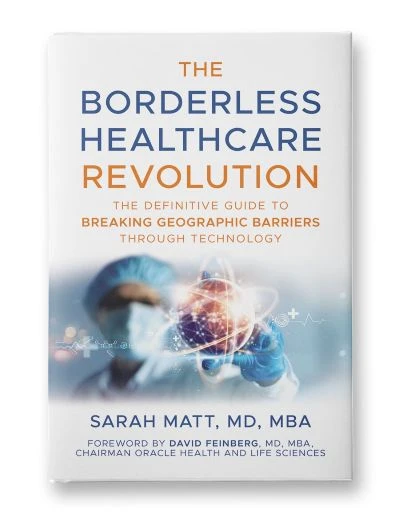
1. Your book highlights what you call healthcare's “geography problem.” From your global experience, what are the most persistent structural barriers that continue to tie healthcare access to physical location?
The geography problem isn’t just about miles. It is a structural failure where your postal code predicts your lifespan. The barriers are vivid: a patient in rural Texas navigating triple-digit heat to reach a mobile clinic, or a family making a 60-mile drive through a snowstorm in Indiana for urgent care. But beneath those physical realities sit the less visible anchors: fragmented licensing, reimbursement structures that reward bodies in chairs over outcomes, and a hospital-centric delivery model that ignores where people actually live, work, and worship.
2. Digital health has long promised to expand access, yet many initiatives fail to reach underserved populations. In your view, what are the key design and implementation mistakes that prevent technology from truly bridging the care delivery gap?
We keep building Ferraris for people who don’t have paved roads. The core mistake is treating technology as the lead singer rather than one instrument in a larger system. We build bandwidth-hungry portals that demand high digital literacy, then act surprised when they fail in low-resource settings. We also suffer from checkbox quality: prioritising administrative data capture over the actual patient experience. When the tool works for the health system but not for the person it’s supposed to serve, that’s not a solution. That’s an expensive workaround.
3. The book emphasises moving beyond vision to execution. What practical frameworks should healthcare systems adopt to translate digital health strategies into scalable, real-world solutions?
Systems need to move from ‘pilot-it is’ to a structured decision framework. I use what I call the Five Pillars of Healthcare Access: every tool must be evaluated against Physical, Financial, Digital, Cultural, and Trust/Knowledge barriers. Launch a remote monitoring device without a workflow for integrating the data into the patient record, and you haven’t built a solution. You’ve bought a gadget. The Five Pillars force the harder question: does this actually reduce barriers, or does it just move them around?
4. Rural healthcare economics remains one of the most complex challenges globally. How can healthcare leaders create financially sustainable care models for remote or resource-limited regions?
We have to stop measuring access by wait times and start asking who never made it through the door. Sustainability in rural and resource-limited settings comes from value-based payment models and orchestration layers that balance capacity across an entire network, not just within a single facility and we need to fund what I call the unglamorous essentials: broadband, devices, and translation services. These aren’t ‘nice-to-haves’. They are a clinical infrastructure.
5. The digital divide remains a major barrier to borderless care. How should healthcare organisations approach technology deployment in communities where connectivity, infrastructure, and digital literacy are limited?
Go where the people are. Bus-stop clinics. Digital literacy pop-ups in laundromats. Low-bandwidth protocols and offline-first design. You can’t drop an app into a community and disappear. Technology deployment in underserved areas requires pairing the tool with Community Health Workers who can walk someone through a portal login over a cup of coffee. The technology is the table. The human is the chair. You need both.
6. Trust appears to be a recurring theme in your work. How can healthcare systems build trust with communities that have historically experienced limited access or structural gaps in care delivery?
Trust is built in drops and lost in buckets. It starts with radical transparency and what I call digital empathy: a genuine reckoning with the fact that these systems were never designed with certain communities in mind. We have to stop labeling patients as noncompliant when the systems were structurally inaccessible to them from the start. Rebuilding trust means hosting listening sessions, sitting with the discomfort of what we hear, and actually changing our protocols and algorithms in response. Not performatively. Structurally.
7. Based on the global case studies in the book, which innovations or healthcare delivery models show the greatest promise for expanding access without compromising quality?
Virtual care orchestration and remote robotics are two of the most consequential shifts underway. When you can route a troponin spike alert from a paramedic’s fingertip to a cardiologist’s tablet in 30 seconds, you’ve turned geographic distance into a rounding error. Remote robotics extends that logic further: the distance between a surgeon and a patient is no longer measured in inches, but in miles, and eventually in time zones. These aren’t futuristic concepts. They’re deployable now, in the right infrastructure.
8. Many health technology solutions are designed in high-resource environments. How can innovators ensure their platforms remain adaptable and effective in low-resource or decentralized care settings?
Innovators need to audit for lived experience, not just usability. If your AI triage tool was trained exclusively on patients with high-speed internet and the latest devices, it will underperform in the field. We need model cards for clinical algorithms: disclosures that surface the demographic composition of training data and flag known gaps. Fairness in AI isn’t a nice-to-have. It is a patient safety issue.
9. Policymakers often struggle to keep pace with healthcare innovation. What regulatory or policy changes would most accelerate the development of truly borderless healthcare systems?
In the US, for example we need to retire the Meaningful Use checklist mentality and replace it with policy that mandates true data interoperability through FHIR standards, creates a national digital health roadmap with real accountability metrics, and locks in reimbursement parity for virtual care. Right now, providers are financially penalised for being efficient. That is a policy design failure, not a clinical one. Fix the incentives, and the innovation will follow. In countries that are closer to a single payer system, this has certainly improved however, we can all be better at standardisation with real accountability.
10. Your career spans clinical practice, digital health implementation, and government advisory roles. How has this multidisciplinary perspective shaped the way you approach healthcare system redesign?
It taught me that the technology is the easy part. The hard part is what I think of as the rhythm section: policy and workflow. As a surgeon, I’ve seen the immediate clinical need. As a strategist, I see the invisible cliffs where patients drop out of care between encounters. That dual lens is why I’m focused on system-level transformation rather than individual experiments. Shiny tools without structural change are just expensive hobbies.
11. Data interoperability and integrated health platforms are frequently discussed but rarely achieved at scale. What role do unified health data ecosystems play in enabling geographically independent care delivery?
They are the connective tissue. Without unified data ecosystems, wearables and patient portals just create more silos with better branding. A truly integrated ecosystem means an Afghan refugee in Berlin and a veteran in rural Syracuse both have their records move with them, regardless of where they’re standing. That portability is not a technical feature. It is a care continuity requirement.
12. Technology alone cannot solve systemic healthcare challenges. What organisational or cultural changes are required within healthcare institutions to support borderless care models?
We need to place lived experience in the boardroom, not just on advisory councils that meet quarterly and file reports no one reads. Organisations must build genuine digital fluency across leadership and be willing to decommission tools that fail on safety or effectiveness grounds. Culture change also requires celebrating wins in human terms, not just dashboard metrics. When a nurse spends less time navigating a clunky EHR and more time with a patient, that’s worth marking. However, your team marks it.
13. For healthcare entrepreneurs and digital health startups, what lessons from your book can help them avoid the “good intentions but poor execution” trap?
Start with the problem, not the solution. Too many digital health startups reverse-engineer a clinical need to fit a technology they have already built. Avoid checkbox quality: if your tool adds 30 minutes to a nurse’s shift, it will be bypassed, regardless of how elegant the interface is. And apply what I call the grandmother test: if your platform doesn’t work for someone with a basic smartphone, limited digital literacy, and a busy life, it isn’t ready for real-world deployment. It’s ready for a conference demo.
14. Looking ahead, what emerging technologies or system-level innovations do you believe will most significantly accelerate the transition toward truly borderless healthcare?
The twin engines are what I call Intelligence without Borders, AI that operates without geographic constraint, and the Robotics Revolution, which is already redefining the physical limits of care delivery. But the real accelerator is a mindset shift I call Zero-Distance thinking: stop designing systems that bring patients to care and start building systems that bring care to patients. Whether that is street medicine, remote surgery, or AI-assisted diagnostics in a community center, the destination is the same. A world where care shows up.
Read the full article — it's free
Register with EuropeanHHM to unlock expert insights, research articles and in-depth industry analysis.