

Healthcare economics is a branch of health administration that cope with scarcity and utilization of resources in health care sector. It poses fundamental tendencies on concerns of cost, effectiveness, availability and impartiality. Healthcare economics majorly focuses on the means through which healthcare services are funded and used in order to inform decision making when it comes to distribution of resources.
What is Healthcare Economics?

General, healthcare economics describes the efficient use of scarce resources in managing the coming up of an effective health/well-being system. The latter apply general economic theory to study the choices made by individuals, providers, insurers and governments. These include decisions related to the management of resources which include expenditure, how health care is provided and how these could impact on the health of an individual or the society.
Specifically, there are several areas of focus in this study. It also reviews the works that cover the demand and supply elements of healthcare services by identifying how consumers make decisions of where to go for care and when. Second, it uses cost and cost-utility approaches to identify the most effective forms of intervention. Third, it expands a discussion of health insurance markets, specifically addressing the subject of risk distribution. Fourth, it looks at the economic analysis of new technologies and treatments in the health sector. Third and lastly, it examines the motivating factors that shape care provision among the providers.
Importance of Healthcare Economics in Management

The principles of economics are considered to be very useful for healthcare managers and policymakers. They help them in rationing this resource more efficiently, developing health programs that are cost-effective and fair, and make the available healthcare funds count for what they are meant to do – improve the health of the population.
Economic rationality entails that the economic analyses point to problems in the system: for example, duplication of functions or underutilization of preventive care - then the resources can be shifted to those that were left underfunded.
This basic principle of healthcare economics is what supports initiatives in forming performance based practice incentives rather than reimbursing quantity.
Cost and Resource Allocation

The key question for any healthcare system is to work with less. This paper aims, due to scarce resources and need for more satisfying health care especially because of demographical and epidemiological changes at the global level, to examine the process of prioritization.
An evaluation of different interventions is done with the help of the economic assessment tools. For example, cost per increment in quantity adjusted life year (QALY) which is similar to cost–utility analysis used to compare the cost of treatments with the benefits attained in terms of quality of life. While QALYs take it a step beyond cost-effectiveness analysis (CEA) by incorporating quality into the analysis by looking at quality adjusted life years. Cost utility analysis (CBA) measures health outcomes in dollars to assess the value for money. They help in deciding on the degree of funding as well as coverage.
Cost Drivers in Healthcare
On the same note, advancement in technology also leads to enhanced diagnostic and treatable techniques, which in turn leads to a rise in the costs incurred. Computers, surgery and new drugs are usually expensive to acquire and integrate into the health care system. Besides, costs for insurance, compliance issues, and numerous billing intricacies create additional overheads in administration.
Healthcare Financing Models
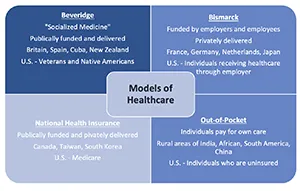
International health care’s functions under numerous funding strategies, all of which have an associated cost. In Beveridge Model shown in the UK, healthcare is funded and controlled by the government through the use of taxes. An example of such systems is the Bismarck Model, popular in Germany, whereby the systems are financed through the payments made by both the employers and the employees.
The Canadian model of health care is the National Health Insurance Model whose care delivery is by private entities but most of which is paid for by insurance by the government. On the other hand, low- and middle-income countries mainly use the out-of-pocket mode whereby people spend their money on the services.
Every system is unique, including its struggles with funding, productivity, or the lack of equal opportunities for all.
Health Insurance and Risk Pooling

Insurance is crucial in managing the economic concerning healthcare. Insurance enables the costs of health facilities to be distributed over a large population group in this manner. However, economic theory has two major presumptions: Downward moral hazard, where insured people are likely to over-utilize services, and adverse selection, where only the worst risk category will seek insurance.
These risks have been controlled by employing insurance features of copayment, deductible, and network. Mandates, subsidies, and risk adjustment are also the methods of shaping public policies to regulate insurance.
Public vs. Private Healthcare Economics
There are some differences between the public and private healthcare from an economic perspective. Public health care has features such as universal access and utilization, equitable access, and can be low cost, will large patient capacities but may lack funding, are underfunded, and the patient may have to wait for long periods before being attended to. Private systems are usually faster in relations to access and innovations but end up developing inequalities, thus accessibility is turned into a commodity.
A mixed economy of healthcare delivery is frequent in existence and one must understand that both a dual and mixed economy, while bringing benefits, is not without its demerits. Strategies such as Public-private partnerships (PPPs) or the vouchers and the use of markets aim at exploiting the advantages of both the sectors.
Economic Evaluation in Health Technology Assessment (HTA)

Health Technology Assessment or HTA is a combination of clinical, economic, and social assessment of the efficiency of the new treatment. It gives a structural approach on assessing whether certain intervention should be funded and adopted.
For instance, there is a new drug for cancer treatment; this drug is capable of protracting life by a few months at a very steep price. HTA determines whether use of resources brought about the improvement in commodities and health related outcome and assists the policy maker in arriving at an informed decision on the usage of the available scarce resources.
Value-Based Healthcare
An interesting innovation in the healthcare sector is the transition from volume to value. In value-based healthcare, attention is paid not only to the provided care quantity but to the results achieved for a specific amount of money.
Economic approaches in value-based care are based on benchmarks, for example, quality of work and service delivery in terms of the acumen of the patients treated. The techniques involved include bundling, shared saving reimbursement model and performance bonus as methods that aim at enhancing quality and efficiency.
Healthcare Economics in Policy Making
Policymakers would also depend on economic inputs in decision making processes. This is because economics offers practical guidelines in areas such as determining the appropriate reimbursement rates for hospitals, controlling the prices of drugs that are crucial for treating the diseases of concern or planning strategies for controlling the disease.
For instance, economic forecasting aids in determining the future impact of such diseases as Alzheimer’s with a view of formulating long term goals. There are also other objectives whereby the budget impact models are useful such as evaluating how new policies will impact on the overall spending of policymakers.
Challenges in Healthcare Economics
However, there is some restriction involved in the study of healthcare economics. Insufficient availability and poor quality of data has always been a problem. The evaluations are challenging because many areas of the world have inadequate health information systems.
Measuring outcomes is another challenge. Of course, health is not always a tangible concept and, thus, it is not an easy thing to evaluate the human life or health in terms of money. Moreover, such political factors tend to tilt the scales in favor of bias and, consequently, fundamental economic factors need to be bolstered with humane aspects.
Global Perspectives on Healthcare Economics
In high grossing nations it becomes closely associated with managing costs and aspiring to be sustainable. Pressure on the Health Services budget are most created by the factors: Aging population increases cost of new technologies and treatments and increases spending expectations. While low- and middle-income countries (LMICs) focus on increasing first-level coverage and the proper utilization of funds from bilateral and multilateral funders.
There are concepts in global health economics that include aid, health system, and universal coverage. Global organizations such as the World Bank and the World Health Organization currently have immense influence on economic policies for health.
The Future of Healthcare Economics
Health care economics in the future will also be determined partly by technology and innovation. However, big data and AI are already making themselves useful in finding patterns for predictive modeling and optimizing utilization of resources. These include mHealth treatment via telemedicine and other products, which presents ways to deliver care to various populations cheaply.
The early treatment will also become more valued with time considering the effects is likely to impact the economic models in future extensively. Moreover, incorporating social determinants of health into economic models will help address the housing, education, and nutrition of the population for better health planning.
Conclusion
The healthcare economics is concerned more than just a cost containment exercise. It is basically the management of scarce resources in a way that will yield the best results. Aging central to the field will be the key to changing how the health care functioning systems work, how policies will be made, and even how the care to be delivered will be given. It is specifically imperative to understand the sheer dynamics that shape the health sector within turbulent times and with demand continuing to soar.