
Medical imaging is an important part of modern healthcare. It comes at a significant environmental and financial cost. A single CT scan consumes approximately 26,000 kilowatt-hours (kWh) per year, while an MRI scan requires up to 134,000 kWh annually - equivalent to the energy consumption of 31 four-person households.
At the same time, healthcare systems worldwide face pressure to balance economic profitability with ecological responsibility. One major contributor to inefficiencies is low- value imaging - unnecessary diagnostic examinations that offer little to no clinical benefit. A meta-analysis of 106 studies estimated that billions of US dollars are wasted annually on redundant imaging procedures.
Radiology has long been perceived as a sector where sustainability is difficult to achieve due to the high energy consumption and infrastructure demands of imaging modalities. However, recent technological advancements - particularly artificial intelligence (AI), guided reporting, and structured reporting - are redefining how radiology departments can improve both efficiency and environmental sustainability
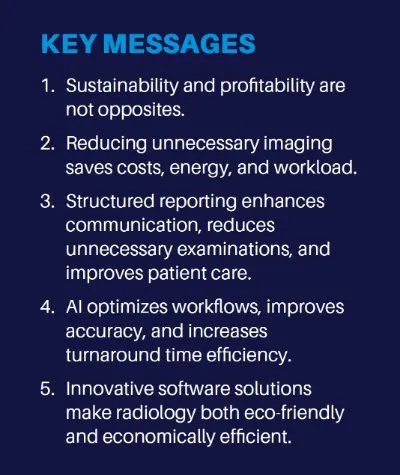
This article explores how digital innovations can help reduce unnecessary imaging, lower energy consumption, and optimize resource utilization. We argue that sustainability and profitability are not conflicting objectives. Hospitals and (tele)radiology practices that integrate AI-driven reporting solutions can not only cut operational costs but also comply with new sustainability regulations while significantly improving their ecological footprint.
1. The Challenge: Resource Waste Through Inefficient Communication and Unnecessary Imaging
Despite advancements in medical imaging, inefficient communication remains a challenge in radiology. Poorly structured reports, ambiguous findings, and missing clinical context often lead to redundant imaging, increasing both costs and environmental impact. Up to 20% of radiological examinations are clinically unnecessary, contributing to rising energy consumption and avoidable patient exposure to radiation.
One key factor is the lack of structured reporting and insufficient communication between the doctors. Traditional free-text radiology reports vary in format, terminology, and clarity, making it difficult for referring physicians to extract the necessary clinical information. As a result, additional imaging is often requested due to uncertainty or misinterpretation, leading to unnecessary repeated scans.
Furthermore, low-value imaging - scans that do not change patient management - drains resources. For example, an analysis of 300 stroke patients found that nearly half underwent redundant neurovascular imaging, largely due to communication gaps between radiologists and clinicians. This inefficiency is not just a financial burden but also a missed opportunity for sustainability.
To address this challenge, software enhanced reporting solutions offer a promising solution by improving clarity, reducing unnecessary imaging, and optimizing resource utilization.
2. The Role of Reporting in Radiology
Radiology reporting plays a crucial role in the diagnostic workflow. Accurate and clear reports are essential for effective communication between radiologists and referring physicians, directly impacting patient management and treatment decisions. However, traditional free-text reports often lack standardization, leading to variability in interpretation and, in some cases, unnecessary repeated imaging.
Modern software solutions have introduced structured reporting technologies that enhance the quality of radiology reports. One such approach is Guided Reporting, which uses decision trees and AI to help radiologists create more structured, precise, and consistent reports.
This approach has proven benefits: Studies show that guided reporting can accelerate the reporting process by up to 40%, allowing radiologists to work more efficiently while minimizing errors. More importantly, clearer communication reduces the likelihood of unnecessary follow-up imaging, directly lowering energy consumption and healthcare costs.
From a sustainability perspective, fewer redundant imaging procedures mean lower electricity usage, reduced contrast agent consumption, and overall resource savings.
3. AI-Driven Optimization of Radiology Workflows
Artificial Intelligence (AI) is transforming radiology by improving workflow efficiency, diagnostic accuracy, and resource management. While AI has primarily been associated with image interpretation, its impact extends beyond diagnosis - helping optimize equipment utilization, reduce energy waste, and minimize unnecessary imaging.
A key study on the return on investment (ROI) of AI in hospital radiology workflows demonstrated:
- 451% ROI over five years, increasing to 791% when radiologist time savings were monetized (Bharadwaj et al. 2024).
- Significant reductions in reporting time, freeing radiologists for higher-value clinical work and patient interaction.
- Lower operational costs through improved decision-making, reducing unnecessary imaging requests and resource waste.
According to Afat et al. (2024), deep learning (DL) accelerated MRI sequences reduce scan energy consumption by up to 72% while simultaneously cutting scan times by 71%.
4. Conclusion: Sustainability, Efficiency, and Better Patient Care – A Unified Approach
Economic and ecological sustainability in radiology are not contradictory goals. On the contrary, by improving communication through software enhanced reporting (structured reporting, guided reporting) and integrating AI solutions, hospitals can reduce unnecessary imaging, lower energy consumption, and optimize workflows, achieving both cost efficiency and environmental responsibility.
Despite known barriers, such as integration challenges, initial costs, and workflow adjustments, the long-term benefits far outweigh these hurdles. Hospitals that take the step toward standardized, AI-powered reporting position themselves at the forefront of high-quality, efficient, and sustainable healthcare.
Ultimately, the greatest beneficiary is the patient. Faster, clearer diagnoses, reduced exposure to unnecessary imaging, and an overall higher standard of care make structured reporting and AI-powered platforms a transformative force in modern radiology. This will a direct impact on patient experience.
References
1. Afat S, Hepp T, Afat C, et al. Sustainable radiology: impact of artificial intelligence and deep learning–accelerated MRI sequences on energy consumption and scan time reduction. Eur Radiol. 2024. doi:10.1007/s00330-024-11056-0.
2. Kjelle E, Palmgren J, Hofmann B. Cost of low-value imaging worldwide: a systematic review. JAMA Health Forum. 2024. doi:10.1001/jamahealthforum.2024.0002.
3. Bharadwaj P, Nicola L, Breau-Brunel M, et al. Unlocking the value: quantifying the return on investment of hospital artificial intelligence. J Am Coll
Radiol. 2024;21(10):1677-1685. doi:10.1016/j.jacr.2024.02.034.
4. Beheshtian E, Nocum DJ, Lakomkin N, et al. Unnecessary imaging in stroke patients: analysis of low-value neurovascular
imaging. Neurology. 2019;92(15):e1809-e1818. doi:10.1212/WNL.0000000000007268.
5. NeoǪ Sustainability Whitepaper. Sustainability in Radiology: Reducing Environmental Impact Through AI-Driven Workflow Optimization. NeoǪ; 2024.