
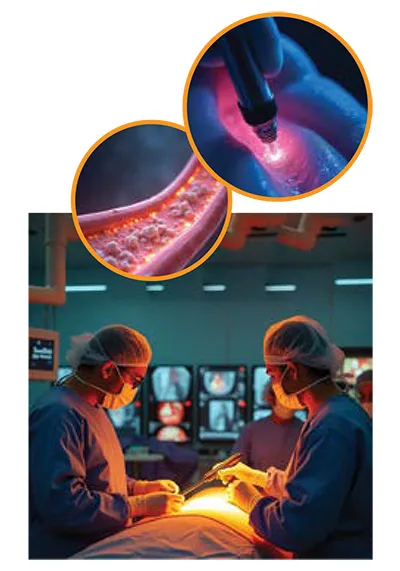
The Effects of Calcified Arterial Disease
Arterial disease caused by calcified plaque buildup in the coronary and peripheral arteries affects millions, especially those who are already suffering from coronary artery disease (CAD) and peripheral arterial disease (PAD). In fact, one in four deaths in the U.S and 17.8 million deaths globally are caused by CAD. Moreover, a limb is amputated every 3-5 minutes in the U.S and one in two patients die from amputations within a year. These statistics underscore the necessity for more effective treatments for artery diseases.
What Is Calcified Plaque?
One of the most pressing problems of cardiac care is plaque buildup in the walls of the coronary and peripheral arteries, also known as atherosclerosis. These narrowed arteries restrict blood flow, reducing oxygen supply to vital organs. Left untreated, plaque buildup increases the risk of blood clots, heart attacks, strokes, and even limb amputation. Unfortunately, rising rates of obesity, type 2 diabetes, and an aging population have led to an increasing prevalence of calcified plaque.
Arterial plaque is the result of the build-up of different substances in the bloodstream like fat, cholesterol, cell waste, fibrin, or calcium. Soft plaque is waxy and unstable, whereas high calcium content causes the plaque to harden, resulting in hard plaque or calcified plaque.
In a study assessing atherosclerosis via B-mode ultrasound in over 6,000 individuals aged 25 to 84, researchers found that 55.4% of men and 45.8% of women had atherosclerotic plaques. Men exhibited a higher proportion of soft plaques compared to women, a difference that increased with age.
Statins, widely prescribed to lower cholesterol, have been associated with an increase in calcified plaque within arteries. While statins reduce overall plaque volume, they also promote calcium deposits, increasing the prevalence of hard, calcific plaque. This phenomenon, known as the “plaque paradox,” suggests that statins stabilize plaque by making it less prone to rupture, though it remains a significant therapeutic challenge.
"We continue to encounter coronary and peripheral disease complicated by severe calcium, presenting a significant therapeutic challenge when employing interventional tools," says Dr. Amir Kaki, interventional cardiologist at Henry Ford St. John’s Hospital, Detroit, MI.
Existing Treatment Challenges for Calcified Plaque
Treating calcified plaque in both coronary and peripheral arteries presents significant challenges.
In coronary arteries, drug-eluting stents are the most common treatment for reopening blockages. However, when calcium buildup is extensive, stent expansion becomes difficult, leading to serious complications such as:
- Restenosis: inadequate stent expansion limits blood flow restoration and increases the risk of the artery re-narrowing.
- Late stent thrombosis: blood clots form inside the stent, increasing the risk of blockages and acute events.
- Major adverse cardiovascular events (MACE): includes heart attacks, cardiac death, and repeat revascularization procedures.
Because of these risks, proper assessment of plaque severity and vessel preparation is crucial before stenting.
The same challenges extend to peripheral arteries, particularly below the knee. These vessels are smaller and less compliant, requiring higher pressures for balloon expansion during angioplasty, which increases the risk of arterial wall injury. Hardened plaque can also:
- Limit device deliverability, making it difficult to navigate and position treatment devices.
- Reduce vessel expansion, preventing adequate revascularization and compromising blood flow.
- Increased stent failure risk leading to suboptimal expansion and long-term complications.
- Raise the likelihood of in-stent restenosis or thrombosis, increasing the need for repeat interventions.
Whether in coronary or peripheral arteries, calcified plaque changes the rules of intervention. As its prevalence grows, so does the need for better tools, refined techniques, and innovative approaches to improve patient outcomes.
Limitations of Traditional Treatments
"Calcium poses significant therapeutic challenges in treating peripheral artery disease, and many of the existing modalities are not optimal for addressing medial and deep plaque," stated Dr. Venkatesh Ramaiah, vascular surgeon at Pulse Cardiovascular Institute in Scottsdale, AZ.
As Dr. Ramaiah mentioned, traditional methods for addressing calcified lesions include balloon angioplasty, specialty balloons (e.g., cutting or scoring balloons), atherectomy devices (drug-eluting, bare-metal, and bioabsorbable), and drug-coated balloons. However, each of these approaches has inherent limitations:
Balloon angioplasty: Often requires significant force to dilate calcified lesions, increasing the risk of vessel dissection or perforation.
Specialty balloons: While designed to modify plaque, they may not effectively fracture deep calcium, potentially leading to inadequate lesion preparation.
Atherectomy devices: These mechanically debulk calcified plaque but require operator expertise and carry risks such as vessel perforation or distal embolization—where fragmented plaque breaks off and travels downstream, potentially blocking smaller arteries.
Drug-eluting stents (DES): Release medication to prevent restenosis but may face challenges in fully expanding within heavily calcified lesions, leading to suboptimal outcomes.
Bare-metal stents (BMS): Lack drug coating, making them more prone to restenosis, especially in calcified arteries.
Bioabsorbable stents: Designed to be absorbed over time, but their performance in calcified lesions is still under investigation, with concerns about proper expansion and support.
Drug-coated balloons (DCB): Offer a non-stent approach by delivering antiproliferative drugs to the vessel wall. However, their efficacy in heavily calcified lesions is limited, as adequate lesion preparation is crucial for optimal drug delivery.
These challenges underscore the importance of exploring more effective strategies for managing calcified arterial disease.
IVL is a Game-Changing Treatment for Calcium
Intravascular lithotripsy is a method of vessel preparation that’s rooted in the efficacy of urologic lithotripsy, which has been used for decades to fragment kidney stones. IVL utilizes a catheter-based approach to fracture hard, calcified plaque in order to modify the vessel for optimal use of other therapies, including the placement of stents or drug-coated balloons.
“A lot of existing treatments weren’t designed with extensive calcification in mind,” says Dr. Kartik Giri, an interventional cardiologist at The Heart House in Cherry Hill, NJ. “We’re seeing older and sicker patients with greater frequency, and current therapies can’t always provide the outcomes we hope for. For example, an option like atherectomy can sometimes feel like trying to chip away at an iceberg with an icepick – it’s just an underpowered tool in some instances.”
During an IVL procedure, a physician inserts a lithotripsy catheter equipped with an integrated angioplasty balloon into the targeted artery. Once positioned, the balloon is inflated to apply low pressure, and the emitters within the balloon generate sonic pressure waves. These waves propagate through the vessel wall, targeting both superficial and deep calcium deposits, while doing no harm to the surrounding soft tissue. They don’t remove or pulverize the calcium, but instead, create small fractures in the hardened plaque, increasing the artery’s compliance and making it easier to treat with other interventional tools.
Some of the clinical advantages of IVL include the following:
Selective calcium modification: IVL's acoustic waves specifically target and fracture calcified deposits without affecting soft tissues, reducing the risk of vessel injury.
Ease of use: The IVL procedure is intuitive and does not necessitate extensive additional training for operators familiar with standard balloon angioplasty techniques.
Safety profile: Clinical studies have demonstrated that IVL is associated with high procedural success rates and minimal complications, including low rates of dissection, perforation, and distal embolization.
Less invasive: Because IVL is less invasive and simpler to use, it is safer for high-risk patients like older adults or those with complex artery disease who may not tolerate more aggressive plaque modification techniques.
“IVL has become a go-to tool for calcium modification and vessel preparation in large part due to its ease of use. I'm particularly excited about the potential of FastWave's IVL devices in critical areas like catheter deliverability and energy durability. These types of improvements will lead to a more reliable first-line approach to tackling challenging cases”, says Dr. Raj Dave, President of Cardiovascular Experts of Pennsylvania in Camp Hill, PA.
Clinical Evidence Supporting IVL
A growing body of clinical research supports the safety and efficacy of IVL in managing calcified coronary and peripheral artery disease.
Disrupt CAD IV: This prospective, multicenter study assessed IVL in patients with severely calcified de novo coronary lesions. Final two-year results from the study showed that the primary safety endpoint—freedom from major adverse cardiovascular events (MACE) at 30 days—was achieved in 92.2% of patients, surpassing the pre-specified performance goal. The study concluded that IVL is both safe and effective for facilitating stent implantation in these challenging lesions.
Meta-Analysis: A comprehensive meta-analysis encompassing 38 studies with 2,977 patients reported a procedural success rate of 97% and a clinical success rate of 93% for IVL in heavily calcified coronary lesions. The in-hospital and 30-day incidence of MACE was 8%, indicating a favorable safety profile.
Disrupt PAD III: This randomized controlled trial demonstrated that IVL was superior to standard balloon angioplasty in achieving primary patency at one year for patients with calcified femoropopliteal arteries. The study highlighted IVL's efficacy in peripheral interventions, noting higher procedural success rates and favorable mid-term outcomes.
The Need for Next-Generation IVL Technology
As the burden of calcified arterial disease continues to rise, the demand for better treatment solutions is growing. Currently, between 18-26% of patients undergoing stent procedures have severe calcified plaque, and this number is expected to increase as the population ages, which is the current trend. While IVL represents a breakthrough, first-generation IVL technology has room for improvement. Here are some of the major pinpoints:
Enhanced deliverability and crossability: Improving catheter design to navigate complex and tortuous vascular anatomies will enable the treatment of a broader range of lesions.
Balloon rupture rates: IVL balloons rupture 10-20% of the time, which is problematic given the high cost of the devices. Advancements in balloon materials can increase resistance to rupture, ensuring consistent performance throughout the procedure.
360-degree energy delivery: Unlike current IVL technology that is unintentionally directional in nature, the application of circumferential energy will enable more uniform calcium disruption, reducing the likelihood of incomplete lesion preparation and improving overall procedural success.
Increased pulse frequency and count: Enhancements that allow for more pulses delivered at a faster rate can decrease procedural time and improve efficiency.
To address these challenges, next-generation IVL devices are essential. By improving catheter deliverability, balloon durability, and energy production, it’s possible to make the procedure even more effective. Innovations such as slimmer, more rupture-resistant balloons and enhanced energy delivery will allow physicians to treat long, diffuse blockages with greater precision and control.
FastWave Medical, a clinical-stage medtech startup is developing next-generation IVL systems. Commenting on FastWave’s technology, Director of Interventional Cardiology at Emory Healthcare, Dr. William Nicholson emphasized, "FastWave's novel approach has enormous potential to leapfrog today's IVL technology with durable, fast, and consistent laser energy”.
The Future of IVL in Treating Arterial Disease
The field of interventional cardiology has evolved dramatically over the past 50 years, with advancements that have improved and extended the lives of millions. IVL is the latest step forward, offering a safer, more effective way to manage severe arterial calcification.
With continued innovation, IVL is expected to become even more versatile, reliable, and effective, ensuring that patients with heavily calcified arteries receive the best possible outcomes. As the technology continues to improve with next-generation devices, IVL is poised to play an increasingly central role in the management of calcified vascular disease worldwide.
References:
1. https://pubmed.ncbi.nlm.nih.gov/32119297/
2. https://pubmed.ncbi.nlm.nih.gov/32119297/
3. https://pmc.ncbi.nlm.nih.gov/articles/PMC3329303/
4. https://pubmed.ncbi.nlm.nih.gov/10591682/
5. https://www.jacc.org/doi/10.1016/j.jcmg.2018.04.015?utm_source=chatgpt.com
6. https://www.jacc.org/doi/10.1016/j.jcmg.2018.04.015?utm_source=chatgpt.com
7. https://www.fastwavemedical.com/intravascular-lithotripsy
8. https://www.ahajournals.org/doi/10.1161/CIRCINTERVENTIONS.119.008434?utm_source=chatgpt.com
9. https://www.jacc.org/doi/10.1016/j.jacc.2022.08.208
10. https://pubmed.ncbi.nlm.nih.gov/38482928/
11. https://www.jscai.org/article/S2772-9303(22)00325-8/fulltext
12. https://www.fastwavemedical.com/