
Some types of pain elude any biomechanical logic. Others stubbornly resist conventional pharmaceutical treatments. As an anesthesiologist specialized in interventional pain management, I have often found myself face-to-face with these gray areas: patients labeled as being in "therapeutic failure," for whom a targeted, reimagined procedure could sometimes change everything.
My practice has led me to work in various settings—from Belgium to Spain, and even Morocco—each with its own protocols, constraints, and resources. Everywhere, a common reality emerges: chronic pain extends far beyond the physical realm. It invades daily life, undermines identity, and gradually isolates patients from their social and emotional world.
It is precisely in these spaces that interventional pain medicine has revealed itself as a valuable tool—not only technical, but deeply human. It has allowed me to offer some patients unexpected therapeutic paths, often absent from traditional care pathways.
Here, I share several cases that have shaped my vision of this demanding and fascinating specialty over the years.
Cervical Radiculopathy and Targeted Neuromodulation
I recall a 50-year-old, active patient suffering from chronic cervicobrachial radiculopathy due to a C6-C7 disc herniation. The pain radiating into his arm disrupted his sleep, affected his mood, and progressively distanced him from his professional activities.
In this case, I combined two approaches: a targeted epidural block and ultrasound-guided neuromodulation of the cervical root. The first provided immediate relief; the second offered longer-lasting effects. Two weeks later, the patient reported complete pain relief, had returned to work, and, most importantly, rediscovered his ease of movement.
Although technically demanding, this type of procedure shows how a targeted approach can restore quality of life where conventional treatments fail.
Pancreatic Cancer and Refractory Visceral Pain
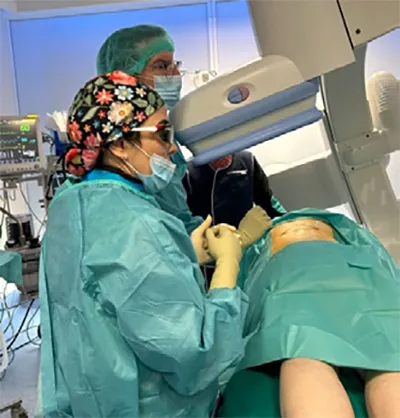
Among the most intense pain I have encountered, that associated with pancreatic cancer stands apart. A 65-year-old patient with non-resectable cancer remained in relatively good general health but experienced daily abdominal pain radiating to the back, despite heavy opioid use.
A celiac plexus neurolysis was indicated. Performed under imaging guidance, this procedure selectively interrupts the nerve transmission responsible for visceral pain. Four months after the intervention, the patient was pain-free, had resumed personal activities, significantly reduced his medication, and described a true return to a dignified life.
This experience underscores that even in advanced oncological contexts, pain can—and must—be addressed differently.
Knee Osteoarthritis and Genicular Nerve Neurolysis
Musculoskeletal pain is another major component of chronic pain. I treated a 48-year-old patient with severe knee osteoarthritis. At the time, surgery was not an option, and the pain prevented him from walking, working, or sleeping.
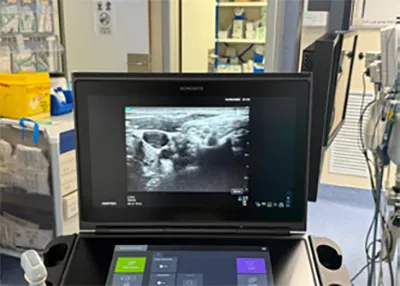
He visited the emergency department almost every night for IV analgesics. We then performed an ultrasound-guided neurolysis of the genicular nerves.
Three days later, he was walking again, had returned to work, and significantly reduced his medication. This minimally invasive intervention perfectly illustrates the functional role of interventional pain medicine: restoring autonomy without necessarily resorting to surgery.
Reflection – A Demanding and Forward-Looking Discipline
Interventional pain medicine remains, in many ways, a specialty of the future. It relies on solid technical foundations, a deep understanding of pain mechanisms, and constant adaptability to both clinical and human contexts. It is a discipline that requires true expertise, built over a long and gradual learning curve.
Each procedure demands precision, caution, and careful consideration of the patient’s history. It is not a “simple” alternative to medication or surgery, but a complementary path—sometimes a decisive one—when standard treatments fall short.
Still emerging in some healthcare systems, it deserves greater integration, better training, and, above all, recognition as a full-fledged therapeutic lever—capable of transforming patients’ daily lives, sometimes with a single intervention.
Conclusion
Far from being just a technical response to pain, interventional pain medicine represents a global, precise, and respectful approach to patients’ lived experiences. In contexts as varied as cancer-related pain, advanced osteoarthritis, or complex neuropathic syndromes, it opens up concrete avenues for relief—where standard treatments reach their limits.
Demanding in its implementation, this discipline deserves a full and rightful place in modern therapeutic strategies. It invites us to rethink our approach to chronic pain—not as an unchangeable reality, but as a phenomenon that can be modulated, soothed, and at times, even overcome.
Interventional pain medicine does not replace—it complements. It enriches our therapeutic toolkit while keeping at its core the fundamental goal of all medicine: to restore the patient’s freedom of movement, choice, and life.