

A Consensus without Consequence
There is broad agreement across healthcare systems that prevention matters. Chronic conditions, type 2 diabetes, cardiovascular disease, and obesity account for the largest share of healthcare utilisation and expenditure across Europe and globally. These conditions develop over years, shaped by behavioral, environmental, and social factors. In many cases, their trajectories are modifiable.
Yet healthcare systems remain organised primarily around the treatment of established illness. Hospitals are built for acute episodes. Payment models have historically rewarded volume. Clinical infrastructure prioritises what has already progressed to a point of intervention.
Value-based healthcare was designed to change this. By shifting attention from activity to outcomes from how much care is delivered to what that care achieves—the framework creates a natural alignment with prevention. If long-term health outcomes are the measure, early intervention becomes operationally essential. That alignment, however, has not been fully realised in most systems.
What Value-Based Healthcare Has Changed
The shift toward value-based care has produced meaningful structural changes. National outcome registries now allow hospitals to compare clinical performance across regions. Integrated care pathways coordinate treatment for complex conditions across specialities and settings. Payment models have evolved bundled payments for episodes of care, capitation for population management, and shared savings arrangements that reward efficiency.
These represent a genuine reorientation of how healthcare systems define and measure performance.
But a critical question remains: how much of this reorientation extends upstream, to the point before patients enter the system with established disease?
Most value-based models still center on the patient who has already been identified. The diabetic whose A1C requires management. The cardiac patient whose readmission risk requires mitigation. The cancer patient whose treatment pathway requires coordination.
Prevention, the work of reaching populations before disease onset remains, in most systems, a structurally separate function. A different funding stream. A different organisational unit. A different set of accountability metrics.
The Infrastructure Gap
This structural separation has operational consequences that warrant closer attention from healthcare leadership.
When prevention is positioned as a program a wellness initiative, a screening campaign, a time-limited intervention—it operates outside the core operational logic of the system. It is funded episodically. It is measured inconsistently. It is among the first functions reduced when budgets contract, precisely because it was never integrated into the infrastructure that the organisation is designed to sustain.
Acute care does not face this vulnerability. Emergency departments, surgical capacity, and inpatient services are treated as essential infrastructure. They are built into the operational architecture of health systems because the system’s continuity depends on them.
Prevention requires the same structural status—not as a matter of principle, but as a matter of operational design. A healthcare system that intervenes only after chronic disease has developed is selecting the highest-cost, lowest-efficiency point of entry into the patient’s health trajectory.
European Approaches: Structural Strengths and Persistent Gaps
European health systems have structural advantages that support the integration of prevention. Primary care is well-established, with general practitioners coordinating preventive services including risk assessment, lifestyle counseling, and chronic condition management. Population-based payment models provide financial alignment with long-term health outcomes.
Public health agencies collaborate with regional authorities and community organisations to address broader determinants of health—nutrition, physical activity, and social environment. National health registries enable population-level monitoring and risk stratification.
These are genuine strengths. They create the conditions for prevention to be embedded across multiple layers of the healthcare system. The integration, however, remains incomplete.
Clinical pathways for chronic disease management rarely extend backwards into structured prevention. Payment models that reward long-term outcomes do not always account for the multi-year time horizons that preventive interventions require. Data systems that track hospital-level performance often do not connect to community health metrics. The components exist. The operational integration between them does not.
Four Requirements for Operational Integration
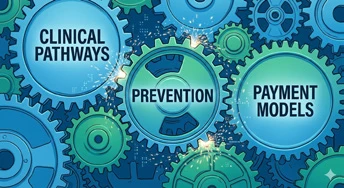
If prevention is to function as infrastructure within value-based systems, four elements must align.
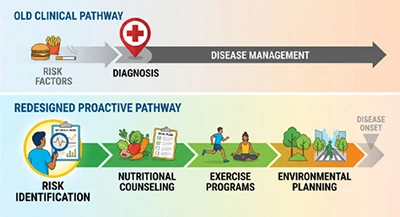
First, clinical pathways must extend upstream. Chronic disease care pathways should not begin at diagnosis. They should begin with the identification of risk metabolic, behavioral, environmental—and include structured intervention before disease onset. This requires redesigning pathways, not appending prevention modules to existing ones.
Second, payment models must explicitly reinforce early intervention. Population-based funding, bundled payments, and shared savings arrangements create theoretical space for prevention. But unless incentive structures reward the reduction of disease incidence not only the efficient management of established disease prevention will remain operationally discretionary.
Third, measurement must match the standard applied to acute care. Outcome registries, population health analytics, and patient-reported outcomes must track preventive impact with the same discipline applied to surgical outcomes or readmission rates. What is not measured with rigor will not be sustained with resources.
Fourth, delivery must extend beyond hospital walls. Prevention occurs in primary care settings, community programs, and the daily environments where behavior is shaped. Partnerships between healthcare providers, community organisations, and public health agencies are not supplementary. They are the delivery mechanism for preventive intervention at scale.
The Role of Digital Health and Population Analytics
Digital health technologies are creating new operational channels for prevention. Remote monitoring, digital coaching platforms, and mobile health applications allow providers to support patients between clinical encounters and reinforce lifestyle interventions at scale. Population health analytics, combined with risk stratification and social determinant data, enable systems to identify who would benefit from early intervention and where resources should be directed.
These tools are necessary but not sufficient. Technology that operates outside an integrated delivery and payment framework will remain a pilot rather than a system capability. The determining factor is not the availability of digital tools, but whether the operational environment is designed to incorporate them.
The Strategic Question
Healthcare systems across Europe and globally face converging pressures: rising costs, aging populations, and increasing chronic disease burden. Value-based healthcare provides a framework for navigating these pressures by focusing on outcomes and long-term health improvement. Prevention is the most underleveraged capability within that framework.
The evidence base for prevention is well-established. The operational question is whether healthcare systems are structured to act on it—whether prevention is built into clinical pathways, payment models, and performance measurement, or whether it continues to operate as a discretionary function outside the system’s core architecture.
How healthcare leaders answer that question will shape outcomes for the populations who have not yet entered the system as patients. That is where prevention either works or does not.
References
1. Porter, M. E., & Teisberg, E. O. (2006). Redefining Health Care: Creating Value-Based Competition on Results.
2. OECD. (2023). Innovative Provider Payment Models for Promoting Value-Based Health Systems.
3. World Health Organisation. (2022). Preventing Noncommunicable Diseases Through Public Health Interventions.
4. National Institute for Health and Care Excellence (NICE). (2021). Prevention of Type 2 Diabetes in People at High Risk.