
History of Surgical Simulation
For more than 2,500 years, surgical simulators have been a crucial tool in the field of medicine. One of the earliest recorded instances of surgical simulation dates back to around 600 B.C. in India when leaf and clay models were used to visualize nasal reconstruction with a forehead flap. Subsequently, wooden bench-top models, live animals and human cadavers were all utilized for surgical simulator training, to devise pioneering procedures and ensure that patient safety was never compromised. Their continued use today is a testament to their effectiveness and the advantages they bring to both medical professionals and patients alike.
In the 1980s, the field of medical simulation witnessed a significant breakthrough with the introduction of computerized patient simulators (manikins) into anesthesia training programs. This development revolutionized the way medical students and practitioners learn and practice their skills, paving the way for more effective and efficient training methodologies. The original manikins employed cutting-edge technology, including microprocessor chips and advanced computer software, to flawlessly imitate vital signs and respond to interventions and emergencies with utmost accuracy and precision. Since then, remarkably realistic computer images have been developed utilizing wireless technologies with high-fidelity human similitude to enable training for a wide range of surgical procedures.
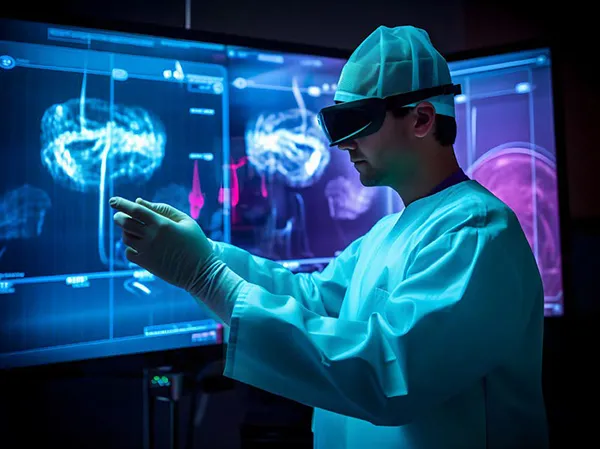
The introduction of VR simulation in the 1990s revolutionized the field of surgical simulation. VR offers immersive, stereoscopic, 3D views of an environment through a headmounted or console-mounted display. VR simulations are state-of-the-art computerbased systems that provide an unparalleled opportunity for surgical trainees to practice surgical techniques. By utilizing advanced tools to manipulate a series of highly realistic computerized images, trainees can perform complex surgeries in a virtual environment, allowing them to hone their skills with absolute precision and confidence. VR simulators have evolved and today they combine physical surgical tools with digital technology by incorporating the latest advancements in both medical equipment and computerized imaging. The next unequivocally impressive advancement in surgical simulation is the creation of simulation programs for the robot-assisted surgical system that instructs inexperienced surgeons on the techniques necessary for performing robot-assisted surgery.
Value of Simulation
Simulation can greatly benefit Cardiothoracic (CT) surgery training due to the high risks and broad range of techniques involved including open, minimally invasive, and endovascular procedures. CT surgery is uniquely suited for virtual reality due to its dynamic anatomy, focus on decreasing invasiveness and commitment to innovation. With a rise in cardiovascular and thoracic disease burden, the number of CT surgeons is expected to decrease by 50% in the next 10 years, leading to a high demand for well-trained and efficient CT surgeons. Simulation can increase learning opportunities, reduce costs, decrease OR time, and help in the seamless integration of new technologies into patient care.
Newly structured curricula are being created that focus on incorporating simulations into the daily training of residents. This dedicated approach aims to improve the quality of training by providing practical experience in a controlled setting. Hybrid simulators represent a valuable tool for improving surgical skills and ultimately enhancing patient outcomes.
Current Simulation technologies
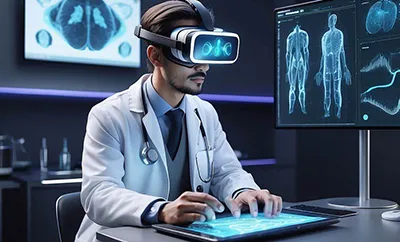
Current surgical simulators fall into various categories of innovations, with significant heterogeneity in their quality and methodology. One involves the use of cutting-edge technologies such as rapid prototyping and patient-specific virtual reality. Surgeons can achieve the highest level of realism by practicing on models that precisely represent their patient’s case. Another involves increasing access to expert surgeons through telesurgery, which can be especially beneficial in remote or underserved areas. Through the Virtual interactive presence and augmented reality (VIPAR) system, the visual field of a surgeon in one location is projected to another surgeon elsewhere through simulation, allowing realtime guidance by a more experienced surgeon. By utilizing augmented reality technology, the VIPAR system enables low-latency audiovisual collaboration over the Internet. Therefore, participants located in different places can join forces to recognize anatomical structures, guide surgical maneuvers, and brainstorm comprehensive surgical approaches.
Cardiopulmonary bypass
A Cardiopulmonary bypass simulator system has been devised to train a team of surgeons, anesthesiologists, perfusionists, and OR nurses together in an OR with a heart-lung machine, heater/cooler system, patient monitor, anesthetic machine, and an artificial patient alternative. This system can be connected to a monitor to display vital parameters, blood gas analysis, and coagulation parameters based on a pre-set model prepared by an instructor. This learning method was found to be better than classroom or clinical-based teaching.
The Virtual Reality Extracorporeal Circulation simulator or VRECC sim is a unique system that helps to build up competency and experience with rare events/machinery malfunctions, without necessitating a physical simulator or jeopardizing patient safety.
Coronary artery bypass
A beating heart simulator system consisting of a porcine heart with right and left ventricular chambers filled with balloons, connected to a computer-assisted pneumatic system allows the balloon inflation to simulate the heart contraction. With artificial blood supplying the entire system, the heart is positioned in a well in the anterior chest wall of an adult mannequin mimicking standard median sternotomy.
In practice, the 3D VR visualization of coronary and thoracic anatomy can help produce a surgical plan for graft locations, as well as optimize port placement in minimally invasive coronary artery bypass surgery for internal mammary artery harvesting, and minithoracotomy positioning.
Valvular repair
Valvular surgeries have been significantly enhanced by VR technology. Surgeons can now visualize different types of valvular lesions with greater clarity, which in turn has increased their confidence in determining the optimal surgical approach. VR shows valvular & annular pathology more clearly than echocardiography. This has ultimately led to better outcomes for patients undergoing these procedures.
Congenital cardiac surgery
VR has a compelling application in visualizing intracardiac malformation during congenital cardiac surgery. A study reported the use of cardiac magnetic resonance imaging to show a 3DVR image of a child with multiple VSDs to both a cardiac surgery team and a cardiac intervention team, and both succeeded in closing these defects via a hybrid approach after VR deemed that the largest VSD approach via the tricuspid valve was impossible. VR 3D anatomical visualization of Major Aorto-pulmonary collateral arteries (MAPCAs) is a valuable tool that can confirm findings not detected by angiography. For Double outlet right ventricle (DORV) cases, VR has helped in improved visualization of the location, a better understanding of the relation to other structures, and the severity of obstruction.
Aortic surgery
Using VR technology, trainees can get familiar with various real-life pathological models and complex cases derived from imaging data of actual patients, which would be highly challenging to replicate using animal tissue.
VAD
VR assists with positioning the inflow cannula for left ventricular assist devices and reduces imaging artifacts associated with implanted devices.
VATS
The Virtual Reality system for VATS lobectomy consists of a computer screen projecting an OR view of a patient in the left lateral decubitus position, transitioning to an internal view of the lung, hilum, and mediastNinum on thoracoscope placement into an artificial chest wall. A haptic feedback device controls the movement of virtual instruments to mimic the physical constraints of VATS.
Lobectomy and Segmentectomy
Using 3D VR visualization, VR-guided segmentectomies and lobectomies have been shown to produce great results.
Impact on surgeon’s skills
VR Simulation training improves accuracy, confidence, and timing during procedures. Significant takeaways include better clinical knowledge, increased confidence in handling adverse events like air embolisms, and improved teamwork and collaboration with the surgical team. A study reported that medical students were able to achieve coronary anastomotic accuracy and scores like those of experienced surgical trainees.
Impact on clinical practice
The ultimate goal of simulation-based training in cardiothoracic surgery is to enhance patient outcomes and service delivery. VR technology is playing an increasingly crucial role in the field of presurgical planning. The ability to create interactive and realistic 3D models of complex anatomical structures is revolutionizing the way surgeons plan and prepare for procedures. With VR, surgeons can explore the intricacies of a patient's unique anatomy in a virtual environment, enabling them to identify potential challenges and develop appropriate strategies to mitigate surgical risk. Moreover, VR offers a more intuitive and immersive experience than traditional 2D images or physical models, allowing surgeons to gain a better understanding of the spatial relationships between anatomical structures. This technology is particularly valuable in cases where the anatomy is complex or aberrant, making it more challenging to visualize using conventional methods. VR planning is making a significant impact on daily clinical practice, particularly in the fields of congenital cardiac surgery and sub-lobar lung resections. Surgeons have claimed that VR planning is the most significant advancement since the introduction of CT scans in the 1970s.
Cost-effectiveness
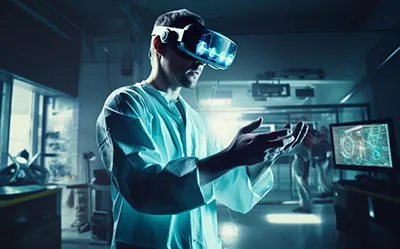
Over the past decade, the financial obstacles to the implementation of VR and augmented reality (AR) in a surgical environment have decreased as more affordable technology with considerably more robust processing capability has become available and the advantages of using VR for enhancing patient safety, surgical education, and quality assessment have become apparent. The costs associated with implementing VR and AR technology in surgical settings are becoming more affordable due to the use and adaptation of commercially available hardware that is non-specific in its use. Recently developed VR headsets provide high-quality visuals and realistic surgeon-hand interactions, thus making these technologies more accessible for healthcare providers.
VR can replace costly cadaveric and animal tissue models in surgical teaching while offering a wider range of anatomical variations. Moreover, VR enables learners to repeat the learning experience, thereby enhancing the effectiveness of the curricula while also leading to long-term cost savings. VR has proven to be an effective and valuable alternative to traditional operating room learning sessions, especially in the context of robotic surgery. This is particularly significant as robotic surgery can be quite expensive to use and implement.
The perks and pitfalls
The major advantages of VR in surgical education include patient safety, the opportunity to make mistakes, global health outreach, remote learning, improved longitudinal training, and evaluation of trainee competencies.
Because simulation tools seem to score high in their potential to mimic reality and their possibility to present a varying set of cases and differing levels of difficulty, there is no doubt in clinical usefulness. Apart from visual simulation advantages, the development of instrumental simulation tools having haptic feedback also seems to add great value to the potential of surgical training simulators in cardiothoracic surgery. All these various benefits of VR surgical training simulators are suitable for use by surgical residents during their training stage, for less experienced surgeons attempting to master surgical techniques, and for experienced surgeons learning new surgical procedures.
VR can not only improve technical skills but also surgical team dynamics. This could involve simulating surgical emergencies, modifying operative planning, or refining communication skills among team members. The implementation of a multiuser platform where trainees can collaborate in a virtual environment could expand the potential of VR beyond technique acquisition.
The global implementation of VR for training purposes is still hindered by a lack of some important features. Despite improvements in this technology over the last few years, some users may still experience discomfort, such as dizziness, headaches, or motion sickness. Users may also become disoriented by extensively manipulating, scaling, and rotating VR patient models in a fully virtual world. Moreover, the lack of tactile feedback remains a challenge for learners who must use controllers instead of real surgical instruments. Other disadvantages of VR in surgical education include financial barriers, decreased human interactions, access to internet connectivity, and possible potentiation of educational inequity.
Future directions
Extended reality (XR) combines physical and virtual 3D interfaces using wearables and remote controllers for human-machine interaction. This includes the sub-techniques of VR, AR, and mixed reality (MR). All these interfaces allow users to view or interact with computer-generated 3D interfaces in a physical and virtual world, either in VR or hybrid (MR and AR) environments. With the instantaneous development of new XR devices, their potential for use in healthcare is unavoidable. It is believed that emerging digital techniques will extensively impact healthcare, particularly in surgical fields where narrow and clear visualization is mandatory.
The swift progress in XR technology presents a promising opportunity to address various obstacles in the surgical field through the development of cutting-edge hardware and software solutions. Further, the advancement of digital systems specified to cardiothoracic surgery will allow more accurate and detailed studies to validate this still unexplored, promis
Conclusion
VR presents a multifaceted opportunity to improve various aspects of clinical education, training, and patient care. It can significantly enhance surgical skill acquisition and confidence among medical professionals by offering a flexible and immersive learning modality. It addresses the critical issue of medical errors by allowing trainees to practice in a safe and controlled environment before transitioning to real-life cases. Although initial implementation costs may be high, the slashing prices of VR technology and the long-term cost-effectiveness point to a promising future. Given these advantages, it is apparent that VR is an invaluable addition to medical education complementing hands-on clinical training. As medical institutions and professionals continue to explore and adapt to this revolutionary technology, VR can transform the field, improving patient safety, surgical outcomes, and healthcare access globally.