
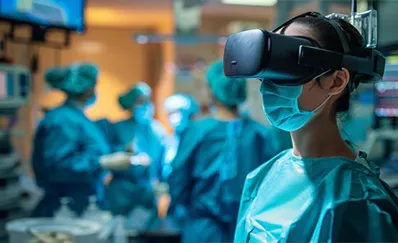
Headsets, screens, and haptics are no longer just for video games. Virtual reality (VR) is now the forefront of medical education, so much so that the VR market in healthcare is expected to see a 22.5% compound annual growth rate through 2027. Physicians are starting to receive more education via VR, and the training is benefiting the physicians, hospital systems, and even patients.
Benefits for Physicians
While cadaver labs, didactic sessions, and mannequins have successfully supported physician learning for decades, they also have their limitations. Physicians can benefit immensely from VR training. VR training offers many unique advantages that aren’t achievable with any traditional methods.
Accessibility is a major reason that makes VR an effective training tool. Physicians can learn either in person or remotely. The flexibility in location is a game-changer for rural hospitals, underfunded facilities, residents who don’t have funding to attend expensive events, and physicians who otherwise wouldn’t be able to attend for a number of other reasons. VR is also easy to set up in nearly any location no wet lab required. Its portability makes it much more approachable to clinicians. The same set of equipment can provide trainings for multiple procedures, too. There’s no need to create an entirely new event for each individual skill or technique.
In addition to the flexibility in location, VR training offers flexibility in timing as well. If physicians have access to VR headsets, they can practice on their own time. Previously, if a physician didn’t understand part of a lecture or didn’t get enough hands-on time in a cadaver lab, it was too late there weren’t any other opportunities. With VR, though, clinicians can practice new techniques and procedures outside of the main instruction time until they feel comfortable.
The extended practice time offered by VR is a fast way to close skills gaps for physicians. Harvard Business Review highlighted the importance of using virtual reality technology to help address skills deficiencies and bolster confidence in physicians, especially for complex procedures. In fact, a study published in Surgeries showed that VR training gives physicians better procedural confidence and surgical performance than textbooks. A similar study showed that practicing with VR simulation increased physicians’ self-efficacy and confidence and reduced their anxiety about tracheostomy-related knowledge and care skills. The more confident and prepared physicians feel, the less likely they are to make mistakes due to anxiety.
The adage “practice makes perfect” is clearly applicable, but what else makes VR such an effective training method? A review of 22 studies published in Laparoscopic, Endoscopic and Robotic Surgery suggested that virtual reality simulation training for endoscopy procedures was seen to be comparable or significantly better than clinical training, no training, and other types of simulation. The publication showed that one of the primary reasons VR is so successful is because VR can give instant, unbiased feedback. This helps correct physicians mistakes quickly and helps them learn faster than traditional methods of teaching. It also helps proctors and professors from confusing good bedside manner and friendliness with actual skills and results.
VR is also a powerful education tool because it can cater to different learning styles and skill levels. Physicians can practice different modules depending on whether they prefer more or less verbal instruction in the simulation or different visuals. Lessons can be repeated and customized to better meet an individual clinician’s needs. The flexibility for different learning styles helps ensure that all physicians are able to take advantage of learning, including physicians who are neurodivergent, are from different cultures or backgrounds, or use a wheelchair or other aids.
Benefits for Hospital Systems
The advantages of virtual reality extend far beyond individual physicians and can lend advantages to entire hospital systems. A primary benefit is reduced training and operation costs. Admittedly, a major barrier to the implementation of VR is the initial sticker shock. VR systems can be expensive, costing tens or even hundreds of thousands of dollars, depending on the setup. However, hospital systems can view VR as an investment: an initial up-front cost ends up paying off over time.
For example, a study published in Computer Informed Nursing discussed how virtual reality was used to train neonatal intensive care workers in hospital evacuation. The initial cost of VR training was more expensive than doing a live drill. Doing a live, in-person drill cost $229.79 per participant, which added up to a total cost of $18,617.54 per exercise. In comparison, VR exercises cost $327.78 per participant and a total cost of $106,951.14. However, over time, VR ended up being a more cost-efficient method. When development costs were extrapolated to repeated training over 3 years, however, the virtual exercise became less expensive and lowered to $115.43 per participant, while the cost of live exercises remains fixed.
As mentioned before, VR makes it possible to train multiple physicians in multiple locations at once, which further cuts down on costs. One publication offered strategies to help absorb the initial investment in VR systems, one of which is having multiple facilities use the same training system and share the costs. The VR system is also easily scalable and can accommodate more (or fewer) trainees, allowing for more participants at no extra cost, as well as no monetary or product waste if there are fewer than expected participants.
Benefits for Patients
Patient impact is a major consideration for any training program. Training physicians with virtual reality has shown to have multiple benefits for patients.
Patients may experience anxiety when they do not understand a procedure or do not understand fully what is going to happen to their body. VR simulations can help patients understand the procedure that the physician will perform as well as help educate them around disease state. A publication in the American Journal of Critical Care studied patients who received virtual reality preoperative educational program before undergoing elective cardiovascular surgical procedures. Compared to patients who didn’t receive VR education, patients who experienced the VR simulation experienced lower durations of postoperative sedation and mechanical ventilation. Most patients in the virtual reality simulation group (92%) said the simulation alleviated their anxiety, helped them understand what to expect in the ICU, and improved their feeling of safety.
Patients can also benefit from VR because physicians can use simulations to customize procedures to a patient’s individual needs. Neurosurgeons are starting to use VR technology to add a three-dimensional view of a patient’s vessels and superimpose it on real-time camera footage from inside the brain. The enhanced imaging adds extra detail for extra precision during aneurysm surgeries. For neurosurgery and many other specialties, VR offers physicians an opportunity to map out a patient’s anatomy. With detailed renderings, physicians can plan out what a procedure will entail, better anticipate a patient’s unique needs and risks, and tailor the surgical techniques all before the operation even starts.
Another example is using VR education to address physicians’ possible race-based biases. One study used VR training modules to help medical students and resident physicians recognize implicit bias and its effects on communication, patients, and patient care as well as practice communicating with BIPOC patients in a respectful and trust-building way. The publication showed that the training improved physicians’ attitudes toward implicit bias instruction. Additionally, physicians placed more importance on determining the patients’ beliefs and providing quality health care and increased their communication efficacy.
Tips for Training Physicians Effectively with Virtual Reality Tools
Virtual reality training is still a relatively new tool for many physicians and hospital systems. If you are considering investing in a VR system or want to get the most out of your existing one, here are some tips to increase the effectiveness of your training opportunities:
• Give physicians a checklist of skills. It’s helpful for clinicians to have clear objectives that they need to master. It helps make their time productive.
• Let them practice a lot. Give clinicians as many chances to train as possible. Try to work around their busy schedules and offer extra time, especially for skills that they may be struggling with.
• Use multi-player scenarios when possible. One of the possible drawbacks to VR training is that many current simulations are made for only one person at a time. That’s not realistic; operating rooms have many people working together at once. To improve collaboration and build teamwork skills, use multi-player scenarios and have trainees work together as much as possible.
• Change scenarios often. If a physician repeats the same course multiple times to master a skill, that’s fine. However, an overly repetitive training experience may not reflect the variation of real-world patient populations or prepare physicians for unexpected challenges during procedures. When possible, offer a variety of different modules that all focus on the same skill but in different virtual environments.
• Discuss the training afterward. VR doesn’t do all the training for you. After practicing simulations, encourage clinicians to ask questions and discuss their experience. Ask them what they learned, what they did and didn’t like, and what they would change. There may still be questions that the training didn’t answer. A discussion afterward helps them solidify what they learned as well as think critically about possible limitations they encountered.
Conclusion
VR has proved to be an effective surgery education training tool. In addition to benefiting the physicians who practice with it, the benefits also extend to hospital systems and to patients. For both effectiveness and cost reduction reasons, VR is sure to have a significant place in the medical education space in the very near future.