

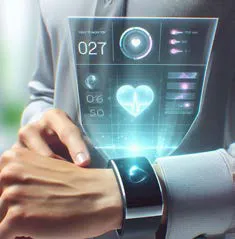
“Wearables” encompasses technological devices designed to be worn on the body, serving practical purposes for users or caregivers. Examples include smart watches and sensory patches. This device monitors sleep, physical activity, and provides physiological data like blood glucose levels or heart rate and rhythm. Increasingly, health professionals utilize wearable devices to gather clinical data on patients. Patients themselves use this wearable digital health technology (DHT) for monitoring diseases, diagnostics, alerts and clinical care services typically through mobile apps or personal digital assistants. The technology is referred to in this series as “Wearable DHT”.
Types of the Wearable DHT:
Several wearable digital health technologies (DHT) devices are currently available. Here are some examples.
- Continuous vital sign monitoring – this device collects real-time health data, enabling timing, timely interventions and personalized patient care.
- Microfluidic patches – small adhesive patches that analyze body biomarkers providing personalized health sites while reducing the need for frequent tests.
- Wearable ECGs – available as smart watches, patches or handheld devices. This ECG syncs with apps that store data allowing physicians to review remotely. They promote proactive health management, early detection of stroke risk, self-awareness, and a healthy lifestyle.
- Respiratory rate monitors – provide real-time tracking of breathing, allow for early detection of health deterioration while maintaining patient mobility. By distinguishing normal respiratory pattern from movement, this device enables proactive care and timely intervention, improving patient outcomes.
- Fall production devices – use sensors and machine learning to assess fall risk in real time. Worn around the waist or clothing, the monitor gait and balance, offering alert to prevent falls, particularly for the elderly and those with mobility challenges.
- Patient monitoring system for pressure injuries – examples like the LEAF system track, patient positioning to prevent pressure injuries. These wearable sensors, alert, healthcare staff for necessary positioning, improving adherence to protocols and reducing hospital acquired pressure injuries.
- Seizure detection devices – provide real-time alerts for seizure activity, helping to manage epilepsy. The night watch system, for example, generalized to chronic seizures, using heart rate and movement sensors, though it is less effective for other types of seizures.
- Insulin therapy devices – continuous glucose monitors, and insulin pumps have revolutionized diabetes management. These devices work together to monitor glucose levels and deliver insulin automatically, creating an artificial pancreas system that improves glucose control and reduces the need for frequent interventions.
- Continuous AI signaling processing – particularly useful for individuals with medical conditions or those in high-risk environments. These devices monitor physical activity and process ECG signals continuously.
- Electronic health record integration – generate real-time data providing a comprehensive view of patient health, improving data accuracy, addressing privacy concerns, and tracking metrics like heart rate, sleep qualities, steps, and COVID-19 symptoms.
- AI patient monitoring - by processing data rapidly, AI power devices can deliver prescriptive and preventive care, reducing healthcare costs, and easing the burden on providers.
- AI-powered robotic prosthetics – using reinforcement learning, these prosthetics adapt to the users' movements, enhancing functionality and improving the quality of life for individuals with disabilities.
- AI-driven predictive analytics – these devices analyze data in real time, anticipating health issues before they escalate. This enables proactive interventions, optimize patient outcomes, reduces hospitalization and lessens the burden on providers.
- Wearable biosensors – these devices detect subtle changes in biomarkers like cortisol levels, providing real-time data for stress management. They allow for targeted interventions, improving patient outcomes.
- Sensor-Embedded Smart Fabrics – these fabrics continuously monitor vital signs and movement offering non-invasive help tracking and reducing the need for clinic visits, improving patient convenience and providing healthcare providers with valuable insights.
- Smartwatches for cardiac care – capable of performing electrocardiograms and detecting irregular heart returns. These devices are major advancements in remote care offering real-time health monitoring and improving diagnostic accuracy.
- Epidermal technology – Comfortable skin patches provide continuous health reading. Physicians can assess near real-time data for quicker intervention and AI. Analyze this data for personalized care, reducing clinic visits.
- Hyper personalized technology - Leveraging AI and machine learning, these devices offer tailored recommendations based on individual health goals and preferences. They motivate users to make healthier choices, enhance appearance to wellness plans and improve health outcomes.
Benefits:
Based on this overview, the expert key issues and concerns related to the use of the above for four main functions: monitoring, screening, detection, and prediction.
Monitoring is the fundamental function of wearables, typically performed by devices like wristbands, patches, watches, and clothing. It involves continuous data collection from individuals, whether from the general population or specific subsets. Wearables are particularly effective for this purpose because they can track a range of biomedical processes depending on the sensors used. Their constant use makes them ideal for remote and continuous monitoring, significantly improving tele monitoring capabilities. Wearables have been instrumental in monitoring vital metrics, such as heart rate, physical activity, and oxygen saturation, especially during the COVID-19 pandemic. In conjunction with telehealth systems, they have also been employed for remote monitoring of at-risk individuals to assist in early diagnosis and hospitalization when necessary.
Screening refers to identifying specific conditions within data sets, collected through monitoring. Wearables, often equipped with passive sensors, measuring motion, steps, pressure, sound, and other variables, have been used in screening for conditions, such as atrial fibrillation, sleep, apnea, and cardiovascular diseases. For example, wearable garments can monitor sleep and screen individuals for sleep apnea by detecting irregular breathing patterns.
Detection is closely linked to screening and involves analyzing wearable data to identify potential. Biomedical conditions can detect patterns that indicate specific health issues and alert users. For example, smart watches have been used to detect actual fibrillation through heart rate monitoring. In some cases, wearables integrate symptom data to enhance the detection of infections, such as COVID-19 or seasonal influenza. Detection often intersects with both monitoring and screening, as seen in smart watches, used to monitor population for irregular pulses and subsequently screen for atrial fibrillation.
Prediction involves using wearable data to infer future health trends, or events. Although fewer wearable devices are currently employed for this function, they show great potential in predicting mortality, clinical risk, and hospital readmissions. Wearables have also been tested for predicting COVID-19 infections days before symptom, onset, and predicting exertion of chronic obstructive pulmonary disease. For instance, accelerometer data from wearables has been used to predict biological age and mortality.
These four functions – monitoring, screening, detection, and prediction – are often interlined, with many devices capable of performing more than one function. Understanding these roles helps clarify both the strength and the limitations of wearable technologies in healthcare.
Limitations and Probable solutions:
In his article, Stephano Canali, and colleagues addressed four main concerns – data, quality, balanced estimation, health, equity, and fairness – while proposing solutions, such as establishing local quality standards, improving interoperability, and enhancing accessibility and representativeness.
Data Quality:
Monitoring through wearables offers great potential due to the continuous and personal data they collect, but a major issue lies in the inconsistency of the data quality. Reliable data is vital for scientific validity and ethical research, but wearable devices often vary Incentive types and data collection methods, making it hard to set universal quality standards. For instance, measurements like oxygen saturation can differ depending on the device (e.g. Wrist, finger, ear) and the sensor's technology. This variability poses challenges for ensuring accurate data. Regulation, such as classifying wearable as medical devices based on clinical validity, could improve reliability. Poor data quality can disproportionately impact vulnerable populations, such as heart patients who rely on wearables to monitor serious conditions or low-income users for whom wearables may be their primary healthcare tool. Therefore, data quality must be evaluated in the context of how and where these devices are used, requiring more transparency in how wearable data is collected, analyzed, and stored. To address these issues, common local data, quality standards and frameworks like FAIR (findability, accessibility, interoperability, and reuse) should be adopted.
Balanced estimations:
Wearables used for health screening and prediction face issues with overestimation and over prediction. For example, wearable devices like Fitbit can detect changes in heart rate or body temperature that might signal COVID-19, but these indicators can also reflect other conditions like the flu. This leads to miss diagnosis and unnecessary anxiety for users. Overestimation of health issues can divert resources away from actual emergencies, leading to imbalances in healthcare. Interoperability – ensuring that wearable data can be integrated with other health data – could help reduce these errors. Higher interoperability would enable comparison between wearable data and other diagnostic tools, helping mitigate over estimation. However, integrating bearable into healthcare systems, present challenges, including staff, training to handle various devices and software differences.
Health Equity:
Wearable devices hold great potential for advancing, personalized and precise medicine, but access to the benefits of this technology is not equal. While wearables can track personal health and fitness, their advantages are often monopoly by large companies such as Apple and Google rather than individual users. Moreover, some users may not be interested in or may find the data confusing or stressful. To ensure equitable access to digital health, the use of wearables must be critically examined in public health policies to prevent the exclusion of those who opt out of using the technology.
Fairness:
The current use of payables in healthcare may disproportionately favor certain groups while excluding others, raising concerns about fairness. For instance, wearables are promoted for monitoring the elderly or patients needing to avoid hospital visits, yet these groups often lack access to such technology. Similarly, children and adolescents may have a varying level of access based on factors like social, economic status and availability of related technologies like smartphones. To ensure fairness, we must prioritize the inclusion and representation of all population groups in wearable, technology, technology, particularly in public health initiatives. Additionally, the context in which wearables are used should be considered, as some populations may benefit less from early detection tools like wearables if other healthcare resources, such as affordable testing, are not available.
Cost-Effectiveness of Wearable DHT:
Gioacchino D. De Sario Velasquez and colleagues conducted a search on March 28, 2023, and identified 10 studies published between 2012 and 2023 from various global locations. The studies suggest that wearable technologies can improve quality adjusted life years, cost-effective, and even cost saving, though their cost-effectiveness depends on factors, such as the type of device, health condition, and local payment structures. Some wearables, like RespiraSense and LEAF Patient Monitoring System, were found to be more effective and less costly than other alternatives. However, cost-effectiveness threshold varies by country, influencing the adoption of this technology. Studies showed a 66% to hundred percent likelihood of wearable being cost-effective. In many scenarios, the sum studies did not report this, highlighting a gap in current research. The findings emphasize that the cost effectiveness of variables is context specific and should be carefully evaluated. More research is needed to fully understand the long-term benefits and the risk of this technology and provide a stronger evidence base for healthcare providers and policymakers.
In conclusion, digital health and wearable technology are revolutionizing healthcare with real-time monitoring and personalized care, offering significant benefits in business management and preventive care. Devices like fitness, trackers and smart watches enhance patient outcomes and streamline healthcare delivery by enabling continuous monitoring and proactive interventions.
However, challenges such as data, quality, health prediction, accuracy, and technology, access disparity need to be addressed. Ensuring data reliability, balancing health predictions, and promoting equitable access are crucial for maximizing the benefits of the wearables.
While wearables show promise in being cost-effective and potentially cost saving, their effectiveness varies based on the device type, health conditions, and local economic factors. Further research should focus on understanding the long-term impacts and risk of the viewable technology to better inform healthcare providers and policy makers.
References:
1. Friend, Stephen H., Geoffrey S. Ginsburg, and Rosalind W. Picard. "Wearable Digital Health Technology." New England Journal of Medicine 389.22 (2023): 2100-2101.
2. Velasquez GDDS, Borna S, Maniaci MJ, Coffey JD, Haider CR, Demaerschalk BM, et al. Economic Perspective of the Use of Wearables in Health Care: A Systematic Review. Mayo Clinic Proceedings: Digital Health. 2024 Sep 1;2(3):299–317.
3. Gioacchino D. De Sario Velasquez, Sahar Borna, Michael J. Maniaci, Jordan D. Coffey, Clifton R. Haider, Bart M. Demaerschalk, Antonio Jorge Forte, Economic Perspective of the Use of Wearables in Health Care: A Systematic Review, Mayo Clinic Proceedings: Digital Health, Volume 2, Issue 3, 2024, Pages 299-317, ISSN 2949-7612, https://doi.org/10.1016/j.mcpdig.2024.05.003.
4. Canali S, Schiaffonati V, Aliverti A. Challenges and recommendations for wearable devices in digital health: Data quality, interoperability, health equity, fairness. PLOS Digit Health. 2022;1(10):e0000104. Published 2022 Oct 13. doi:10.1371/journal.pdig.0000104